0:00
Hi friends, hope you're fine. From the
0:02
Himalayas to the Andis mountain, as you
0:04
see here, these extreme environments
0:07
were once barren rocks. No soil, no
0:10
water, no chance of life. How these
0:13
barren rocks turned into a vibrant
0:16
forest. This epic transformation is
0:18
called ecological succession. In this
0:21
video, we'll be discussing what is
0:23
ecological succession with an example.
0:25
the cerosier and the status of zerosier
0:27
that is succession that is happening in
0:29
dry habitats within 5 to 10 minutes.
0:31
Let's begin with the definition.
0:33
Ecological succession is a gradual
0:36
replacement of one community with other
0:38
in an area until forming a final stable
0:41
climax community over a period of time.
0:43
Now let us see how this works. The
0:46
cerosier refers to succession that is
0:49
happening on dry habitats that is water
0:51
deficient environments like rocks or
0:53
rocky mountains which is called as
0:56
lithosier then deserts sandunes or bare
0:59
rocks. It is called as sirak succession.
1:02
Now let us see the stages to understand
1:04
how these happens over a long period of
1:07
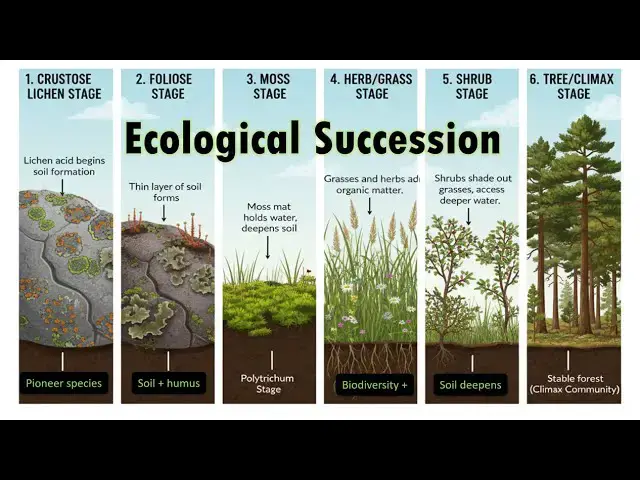
time. So these are the different stages
1:09
of zeros here. Let us break it down into
1:13
each stage for better understanding.
1:15
Starting with the first stage which is
1:16
called the crust to lyken stage. So
1:19
these are the lychans that first grow on
1:22
this barren rocks. They are tolerant to
1:25
extreme environments. They are the
1:27
pioneer species to start the succession.
1:31
These include risocarbon and many other
1:34
species depending on the climate whether
1:36
it is temperate or tropical. These
1:38
lychans secrete acids that break down
1:41
rocks into fine tiny particles and thus
1:44
beginning the formation of first thin
1:46
layer of soil. So the piner species or
1:49
lychans first colonize this parent rocks
1:52
to start the process of succession. So
1:54
these are crusttos lyen that is firmly
1:57
attached to the substratum or rock at
1:59
many points it is attached firmly
2:02
attached to the substrum as you see
2:04
here. This is followed by folio lyken or
2:07
folio stage. So this lyken as you see
2:11
this lyken is not completely attached to
2:15
There are leafike emergence or leaf like
2:19
structures or thalus that is emerging
2:21
out from the rock. Along with this folio
2:24
lyken there will be fruicose lyken or
2:27
bushy lychans like this. They retain
2:30
more water and contribute more organic
2:32
matter. Adding humus improves soil
2:35
fertility allowing more animals or
2:38
organisms to settle. The amount of soil
2:41
increases at each stage along with
2:43
humus. The third stage is the mos stage.
2:47
There is enough soil for the mos pore to
2:50
germinate. So this is polyrichum.
2:53
Moses like polyricum spread across the
2:55
surface forming a mat. And these mosses
2:58
have risoids that penetrate deeper into
3:03
and this absorbs more water and
3:05
minerals. Many associated insects and
3:07
other animals also comes to the side.
3:11
Soil becomes thicker and more stable and
3:13
this mo stage is replaced by herb and
3:16
grass stage. As the soil gets deeper,
3:20
these most plants are replaced by seeds
3:22
of drought tolerant herbs arriving via
3:24
wind or animals. These plants as you see
3:27
here have deeper roots and enrich the
3:30
soil with organic matter. Biod diversity
3:34
begins to increase. Common species in
3:36
tropical regions are grasses like aristo
3:40
etc. So these are trot tolerant grasses.
3:44
Now it is the turn of shrubs. Once the
3:47
shrubs grows it shade out grasses so the
3:50
growth of grasses diminishes and this
3:53
produces tap roots deeper roots
3:56
stabilizes the soil further
3:59
provide more shelter and shade creating
4:01
microhabitats for many animals. Soil
4:04
moisture retention increases fertility
4:06
improves as more organic matter is
4:09
adding into the soil and the final stage
4:12
is called the tree stage or the climax
4:14
stage. Trees like fus in tropical
4:17
regions whereas oak or oaks in temperate
4:21
regions these are trot resistant species
4:23
that begin to appear first. In the final
4:26
stage a stable mature self- sustained
4:29
forest forms that is suited to the local
4:32
climate and this is the final stage of
4:35
succession which is self- sustained and
4:37
self-reliable which is rich in
4:39
biodiversity and ecological balance. So
4:42
for this process to happens for a
4:44
primary section it takes more than
4:45
thousand years. That is why a forest
4:48
once destroyed it's very difficult to
4:50
recreate this composition. Let us go
4:53
through the definition once more. So
4:55
ecological succession is a gradual
4:57
replacement of one community that is
4:59
starting from this lychans the pioneer
5:01
species with other in an area until
5:04
forming a final stable climax community
5:07
which is self- sustained community over
5:09
a period of time. The process is called
5:11
as ecological succession. So here we
5:14
have discussed the ecological succession
5:16
that is happening on rocks or
5:18
trihabitats which is called as cerosia.
5:21
Hope you understand the process of
5:23
ecological succession and the stages in
5:25
cerosia. Take care, stay blessed. Thank
5:28
you so much. You are with biology exams