0:00
Hi friends, in this video let us
0:02
understand the different plant tissue
0:04
systems. Once we have a section under
0:06
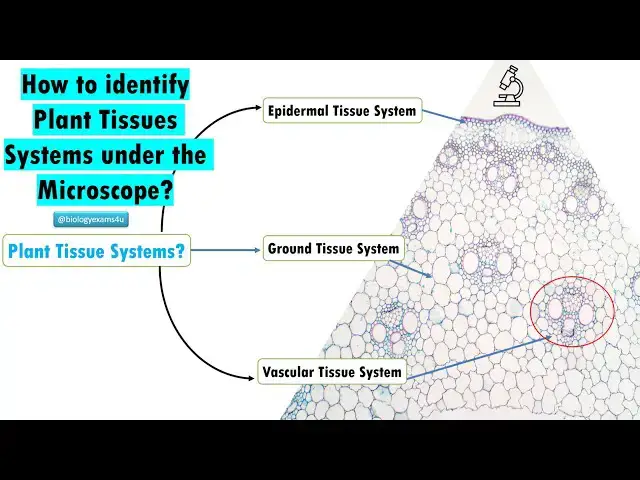
the microscope like this. So this is a
0:08
section of a monocode stem. The plant
0:11
tissue systems are the first one is the
0:14
epidermal tissue system which forms the
0:16
outer protective layer as you see here.
0:19
Then there is ground tissue system. All
0:22
tissues other than epidermal and
0:23
vascular tissues this region. And the
0:26
third tissue system is the vascular
0:28
tissue system that is involved in
0:30
conduction of food and water that is
0:32
sylum and fo. So this is the vascular
0:35
tissue system. Now let us see the
0:37
details. The first one is the epidermic
0:39
tissue system which forms the outer
0:41
protective layer. So this is epidermal
0:45
tissue system. Once we zoomed in we can
0:47
see like this. Here you can see this
0:50
epidermal tissue system. Above that
0:52
there is a cuticle a waxy coating that
0:55
helps in reducing water loss by
0:58
transpiration. Then there are tricoms
1:01
and lower epidermis there is tomato that
1:03
is meant for gaseous exchange. Epidermal
1:06
tissue system is outermost protective
1:08
layer covering all external surfaces of
1:10
plants that is leaves stem root etc. The
1:14
main components are epidermis that is
1:16
made up of single layer of compactly
1:19
arranged cells without intracellular
1:21
spaces primarily parangama cells. Above
1:24
this epidermis there is a waxi layer
1:27
which is made up of cutin often covers
1:29
the aerial parts to minimize water loss
1:33
and to protect mechanical injuries. Then
1:36
there are stomata. They are small pores
1:39
that are guarded by two kidney-shaped
1:42
guard cells that helps in case exchange.
1:44
Tricoms may be there as we mentioned
1:47
there are hairike outgrowths on leaves
1:49
and stems. Sometimes the function may be
1:51
preventing hairpa or act as a repellent
1:53
reflects light or reduce evaporation.
1:56
Then there are some special
1:57
modifications like tissue in orchids as
2:01
you see this is a wamament tissue that
2:03
absorbs atmospheric moisture. Then there
2:06
are bully form cells. So this is a bully
2:08
form cells. Enlarge cells in grasses
2:12
that helps in leaf folding to reduce
2:14
water loss when the temperature is high.
2:17
So this is about the epidmal tissue
2:19
system. Now moving to the next tissue
2:21
system which is a ground tissue system.
2:23
So this is a ground tissue system.
2:25
Ground tissue system comprises of all
2:27
tissues excluding epidermal and vascular
2:30
tissues that forms majority of plant's
2:33
body. The major components are
2:35
paragamata cells as you see here that is
2:37
a lightly stained loosely packed thin
2:40
wall cells that is involved in
2:41
photosynthesis. Then it is called as
2:43
chloranka storage and healing. In the
2:46
last video we discussed about different
2:48
types of plant tissues. You can refer
2:50
that for more. Then this is a parang
2:53
cells. Then colona is present that
2:56
provides flexible support especially in
2:59
stems and ples that is seen just below
3:01
the epiderms. Scaranga may be present.
3:04
As you see here, there are thick wall
3:06
lignified cells that provides rigidity
3:09
and strength. Hypodermis is made up of
3:12
either colanga or scaranga that provides
3:16
mechanical support. This region is a
3:18
hypodermis just below the epidermis. And
3:21
cortex region is made up of primarily
3:23
parang cells. Function is storage. Then
3:28
the innermost ccotical layer in the case
3:30
of vot stem controls flow of substances
3:33
into vascular tissues. There may be
3:38
Then perisycle there is a thin sound
3:40
just inside and armis that is important
3:43
for root formation or root branching. In
3:46
the case of stem there is a central pit
3:49
a prominent region that is made up of
3:52
paranga cells present in stems. The
3:55
third type of tissue is a vascular
3:56
tissue system which is asylum and flow
3:59
up. So this is arranged as vascular
4:02
bundles in monocode stem. As you see
4:04
here this is a sylum and this is a
4:06
phium. You can refer our previous video
4:09
for more. The components of the vascular
4:11
tissue system is connective tissue that
4:14
is composed of sylum for water transport
4:16
whereas phium for food transport or
4:21
The major components are asylum that
4:23
includes tracheets, vessels, hypers,
4:25
parangma cells that helps in moving
4:28
water and minerals upward and also
4:29
provide mechanical support that is
4:32
provided by silo fibers.
4:36
So this is as you see here this is a
4:38
phium that is made up of seat tubes,
4:41
companion cells, fibers and parangma
4:43
cells that transports organic food in
4:47
upward and downward directions. The
4:49
distribution it is often arranged in
4:51
strands or bundles throughout root, stem
4:53
and leaf. Let me summarize. The first
4:56
tissue system is epidermal tissue system
4:58
that forms the outermost protective
5:00
layer with cuticle or tricom. Sometimes
5:04
there may be valamin tissue or
5:05
polyiforform cells. These are some
5:07
specialized structures. Then there is
5:10
crown tissue. Everything other than this
5:12
epidermal tissue system and vascular
5:14
tissues construed crown tissue system
5:15
which is primarily made up of parang
5:17
cells. as you see here involved in
5:19
storage and the third tissue system is a
5:21
wasar tissue system that is involved in
5:23
conduction of food and water that
5:25
consists of both sylum and phium. This
5:28
is arranged as wasclarabundantil and
5:30
this is asylum and this is the phium.
5:32
Sylm involved in conducting water to
5:34
upward regions of the plant whereas
5:36
phium is involved in transferring
5:38
photosynthets to different parts of the
5:41
plant. Hope you are clear with plant
5:43
tissue systems. Take care stay blessed.
5:46
Thank you so much. You have a biology