0:00
Hi friends, in this video let us understand the classification of neurons based on structure
0:06
Neurons are the basic structural and functional unit of nervous system responsible for receiving
0:12
processing and transmitting information throughout the body. Neurons are made up of three main parts
0:18
Let's begin with dendrite. So this is a fine dendritic branches and this is meant for receiving
0:25
signals from another neuron or dendrites are involved in reception of signal from another
0:31
neuron. They are short fine branches and the second structure is the cell body also called as soma
0:40
Cell body is the core part or the central part of this neuron with nucleus, DNA and all other
0:48
organelles like endoplasmic reticular mitochondria etc. It generates neural impulses. It is involved
0:56
in maintaining and also controlling all activities of this neuron and also provides energy. And the
1:03
third part is called the axon. Axon is the long single process or extension that carries signals
1:12
away from the cell body. So this is a cell body. Axon carries signals away from the cell body
1:19
Then this telodendria are fine branches of axons and axons ends in synaptic terminal through which
1:28
this nerve impulse is transmitted to the next neuron. Another region is called as the axon
1:34
hillock. So it is this pyramidal region that connects this axon to this cell body. This site
1:41
is involved in primary integration of neural impulses So from here this neural impulses is transferred to axon then it is transferred to the next neuron through this synapse and the final structure is called this
1:58
myelin sheath. So this is actually an insulation a fatty coating that covers this axon that helps
2:05
in acute nerve impulse transmission and also serves as a protection for this axon. So this
2:12
is about the structure of neuron. Now let us understand the classification based on the
2:17
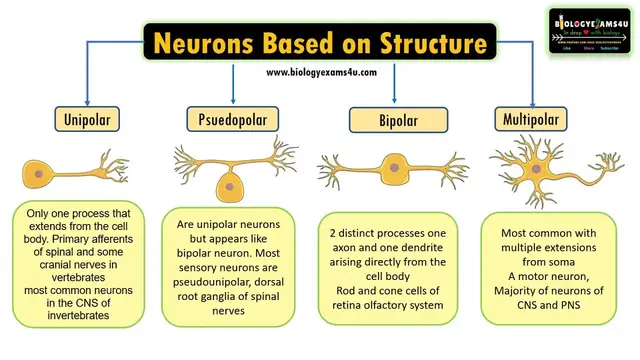
structure of neuron. Neurons are classified into unipolar, pseudopolar, bipolar and multipolar
2:24
neurons. Let's begin with unipolar neuron. As you see this is an unipolar neuron. It has only one
2:31
process that extends from the cell body. The question is what do you mean by a process? In the
2:38
case of neuron, a process is a long thin extension of the cell body that carries signals to or from
2:45
other cells. It's also called as neurite. The two main processes in a neuron are the dendrites and
2:53
the axon. In the case of unipolar neuron, it has a single process or a single extension
2:58
that extends from this cell body. The process is often an axon but branches of axon sometimes
3:06
functions as dendrites. The peripheral process is associated with sensory reception and the
3:14
central process is associated with transferring signal to the central nervous system. So unipolar
3:21
neurons are found in peripheral nervous system and they are responsible for transferring sensory
3:27
information from the skin muscles and other organs to the central nervous system. It is the most
3:33
common neurons in the CNS or central nervous system of invertebrates So unipolar neuron has a single process or an extension that is often an axon Second one is pseudo unipolar neuron This is actually a unipolar neuron
3:51
but appears like a bipolar neuron due to this bifurcation. Most sensory neurons are pseudo
3:59
unipolar. It has a single process that extends from the soma like a unipolar cell but this process
4:07
later branches into two distinct structures like a bipolar cell. Most of these processes are axon
4:15
with peripheral processes often functions like dendrites. Most sensory neurons are pseudopolar
4:23
and have an axon that branches into two extensions like this. One connected to dendrites that receives
4:31
sensory information and another transmits the information to the spinal cord. So pseudopolar
4:39
neurons share the characteristics of both unipolar and bipolar neurons. The next one is a bipolar
4:46
neuron. Bipolar neuron as the word indicates it has two processes or two extensions that extends
4:53
out from the cell body. One of which is axon and one dendrite extending from the soma. They are
5:00
responsible for transmitting sensory information from the periphery to the CNS or central nervous
5:06
system. Road and consuls of retina olfactory system all have this bipolar neurons. An example
5:13
of bipolar neuron is the retinal bipolar cells which receives signals from
5:19
from photoreceptors that are sensitive to light and transmits the signals to the
5:24
ganglion cells that carry the signal to the brain and finally multipolar neurons multipolar as the term indicates it has three or more processes or extensions that arise from the cell body Each multipolar neuron contains one
5:41
axon as you see here and multiple dendrites as you see there are many dendrites. They are the
5:48
most common and abundant neuron in the human body. They are found in both CNS and also in peripheral
5:55
nervous system. Multipolar neurons are responsible for wide array of functions including sensory
6:01
perception, motor control, learning etc. A classical example of a multipolar neuron is the
6:08
Purkinje cell in the cerebellum which has many dendrites just like this with a soma then a single
6:16
axon that arises from the cell body. So these are the four types of neurons based on structure
6:24
Let me summarize. First one is multipolar neuron. The number of processes three or more. Location
6:32
central nervous system and peripheral nervous system. Functions, sensory perception, motor control
6:37
learning, thinking etc. Bipolar neurons. The number of processes is two. Location, retina and olfactory
6:44
system. Major function is sensory perception. Unipolar neuron. There is a single process
6:51
primarily located in peripheral nervous system that is involved in sensory perception. Finally pseudo unipolar neuron basically it is actually an
7:01
unipolar neuron that appears like bipolar neuron with a single function. Location is spinal cord and the major function is sensory perception. So these
7:13
are the four types of neurons based on structure. Hope you are clear. Take care
7:18
Stay blessed. Thank you so much. You are with biology examsforay.com