
0:02
Understanding of these terms chromatin
0:04
and chromosome is very crucial in
0:06
understanding cell division that is
0:08
mitosis or meiosis. The most important
0:11
point is both are chemically same but
0:14
represent different structural states of
0:16
the same genetic material that is DNA
0:19
complex with proteins depending on
0:21
stages of the cell cycle. Now let us see
0:24
chromatin and chromosome. So this is the
0:27
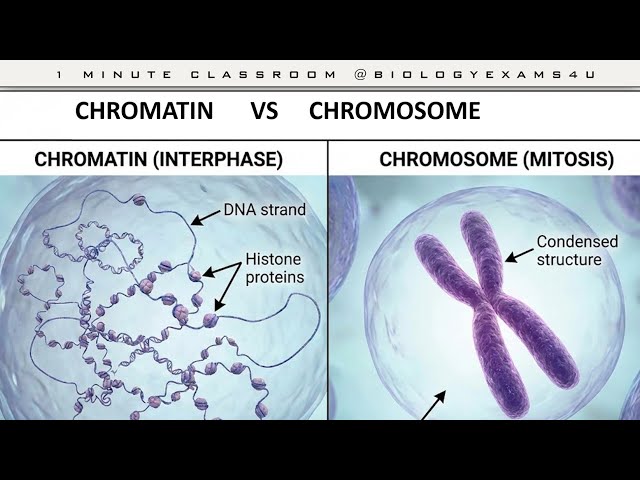
chromatin under electron microscope. So
0:30
chromatin cannot be seen as distinct
0:33
unit under light microscope. It is seen
0:36
as beads on a string structure under
0:38
electron microscope like this. Whereas
0:41
chromosomes on the other hand under
0:43
ordinary light microscope it is clearly
0:45
visible as distinct units. Chromatin is
0:49
relaxed fine thread-like form of DNA
0:51
that is found in the nucleus during the
0:54
interface stage. Whereas chromosome
0:57
are tightly or highly condensed
1:01
that is organized structures of DNA that
1:04
is visible during cell division or
1:06
mitosis or meiosis. So as you see this
1:09
is chromatin these are thread fine
1:11
threads. When we zoom in you can see the
1:14
these threads are wrapped around histone
1:19
Whereas chromosomes this is a metaphase
1:21
chromosome the most condensed form of
1:24
chromosome that we normally use for
1:26
kotyping. Now let us see the difference.
1:28
Chromatin it is a lower order of
1:31
organization of DNA as far as
1:33
condensation is concerned. Whereas
1:35
chromosome is the most condensed form of
1:38
DNA especially the metaphase chromosome.
1:42
Chromatin appears as thin long
1:44
thread-like fibers often called as
1:46
chromatin reticulum spread throughout
1:48
the nucleus during the interface stage
1:51
whereas chromosome are thick distinct
1:54
rod-shaped structures that is seen under
1:56
microscope during mitosis or meiosis.
2:00
Chromatin is metabolically active that
2:03
allows transcription, replication and
2:05
gene repulation. Whereas chromosome is
2:08
highly condensed therefore metabolically
2:10
inactive. The purpose is accurate
2:14
physical separation of genetic material
2:16
into daughter cells during cell
2:20
And finally chemically chromatin is made
2:23
up of DNA with histone proteins. Then
2:26
there are nonhistone proteins with some
2:28
amount of RNA that is needed for
2:30
transcription or gene regulation.
2:32
Chromosomes are also chemically same DNA
2:34
with histone proteins and non-histone
2:36
proteins but with very little RNA as
2:40
chromosomes are generally metabolically
2:42
inactive not accessible to enzymes or
2:45
RNA that it that is needed for gene
2:48
regulation. They get stabilized.