0:01
Hi friends, this quiz will help you to
0:03
learn circulatory system with 30
0:05
questions at three different levels and
0:07
you have 7 seconds to answer. Question
0:10
number one, what is the main function of
0:12
the circulatory system? The options are
0:14
digestion, respiration, transport of
0:16
materials, movement. Your time starts
0:27
Circulatory system transports oxygen,
0:29
nutrients, hormones and waste throughout
0:34
Which of the following are major
0:35
components of the circulatory system?
0:37
Options are heart, blood and lungs,
0:40
heart and lungs, heart, blood and blood
0:42
vessels, heart and blood.
0:50
Circulatory system is made up of heart,
0:52
blood vessels and blood. The lengths are
0:54
part of respiratory system not the
0:56
circulatory system. The human heart is
0:59
made up of how many chambers?
1:15
The heart has four chambers as you see
1:17
here. two atria and two ventricles.
1:21
Which blood vessel carries blood away
1:26
Vins, arteries, capillaries, venules.
1:37
It is the arteries that carries blood
1:39
away from the heart whereas veins bring
1:41
it back to the heart.
1:44
Which component of blood carries oxygen?
1:49
plasma platelets RPC WBC.
2:00
The answer is RBC orthraite that
2:02
contains hemoglobin that can binds to
2:07
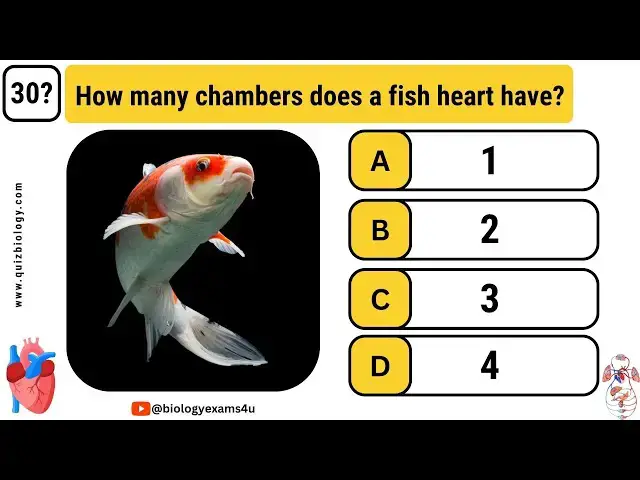
How many chambers does a fish heart
2:24
fish heart have two chambers consisting
2:26
of one atrium and one ventricle which
2:29
allows single circuit blood flow
2:32
which is the largest artery in the human
2:34
body. Pulmonary artery, iota, coronary
2:37
artery, corroted artery.
2:48
Iota carries oxygenated blood from the
2:50
heart to the rest of the body.
2:54
Which part of the heart receives
2:56
deoxxygenated blood from the body? Left
2:59
atrium, right atrium, left ventricle,
3:11
Deoxxyated blood enters the right atrium
3:14
via superior and inferior venneavas you
3:20
What prevents backflow of blood in
3:22
veins, sphincters, wallves, muscles,
3:34
wallves prevents backflow of blood into
3:40
What is the average normal human heart
3:42
rate at rest? 30 to 50 beats per minute,
3:46
60 to 100 beats per minute, 100 to 150,
3:49
150 to 200 beats per minute.
3:55
It is 60 to 100 beats per minute at
4:03
Which side of the human heart pumps
4:07
Right side, left side both neither.
4:19
As you see here, it is a left side that
4:21
pumps oxygenated blood into the systemic
4:26
What type of circulation carries blood
4:28
between heart and lungs?
4:31
Pulmonary systemic portal coronary.
4:42
It is a pulmonary circulation that
4:44
transports blood between the heart and
4:49
The coronary arteries supply blood to
4:54
brain, heart muscles, lungs, body.
5:06
Coronary artery deliver oxygenated blood
5:08
to the mioardium or heart muscles.
5:13
What's the primary function of
5:18
Oxygen transport, immunity, blood
5:20
clotting, heat regulation.
5:30
The primary function of platelets is
5:32
coagulation and stop blood loss by blood
5:37
What is the approximate total volume of
5:39
blood in an adult human being? 1 liter,
5:50
It is five liters of blood
5:53
in an adult human being.
5:55
What is systolic blood pressure?
6:00
Pressure during relaxation, minimum
6:02
pressure, pressure during contraction,
6:13
It is a pressure in arteries when
6:15
ventricles contract or pressure during
6:19
Which chamber of heart pumps blood to
6:21
the lungs? Left atrium, left ventricle,
6:24
right atrium, right ventricle.
6:32
So it is a right ventricle as you see
6:33
here. It sends deoxxyated blood to the
6:40
Which part of the blood is mostly water
6:42
and makes up about 55% of its volume?
6:44
RBC's WBC's plasma platelets.
6:55
Plasma is a liquid part of the blood
6:56
containing mostly water and dissolved
7:02
Which instrument is used to measure
7:07
Thermometer, barometer, spigma
7:10
manometer, stethoscope.
7:18
Spigma manometer measures systolic and
7:25
Which vein carries oxygenated blood?
7:30
Pulmonary vein, vennea, chukular vein,
7:41
The answer is pulmonary vein that
7:42
carries oxygenated blood from lungs to
7:45
the heart as you see here.
7:48
What is the pacemaker of the human
8:04
It is the sinoatrial node or SA node
8:07
that generates impulses initiating
8:09
heartbeat rhythm. This is the SA node.
8:12
Which heart sound is produced by the
8:14
closure of atrio ventricular valves? Lap
8:18
sound, tap sound, murmur sound, click
8:28
The first hard sound, lep occurs when AV
8:31
valves close during ventricular
8:35
Which of the following blood components
8:37
lacks a nucleus in humans? WBC RPC
8:51
mature red blood cells or RPCR a
8:53
nucleate to increase oxygen carrying
8:57
Which structure connects the right and
8:59
left atria in the fetal heart? Ductus
9:04
forammen o ductus venosis. Ligamentum
9:14
famino allows blood to bypass fetal
9:17
lungs by connecting the atria.
9:21
Cardiac muscle contraction is initiated
9:23
by which ion? Sodium, calcium, potassium
9:36
Calcium ions trigger contraction by
9:38
binding to troponin in cardiac muscle.
9:40
The answer is calcium.
9:47
Blood in amphibians, blood in fish,
9:49
blood in open circulatory system, blood
9:52
in closed circulatory system.
9:58
It is a fluid that circulates in an open
10:00
circulatory system mixing with
10:01
industrial fluid to facilitate nutrient
10:03
and gas exchange in insects and
10:05
molllesk. What is double circulation?
10:09
Blood flows only once through the heart.
10:12
Blood flows twice through the heart per
10:14
cycle. Blood flows once through the lens
10:17
and heart per cycle. Blood flows through
10:19
two hearts simultaneously.
10:25
Double circulation refers to two
10:27
separate circuit units. One for
10:28
oxygenation in the lungs and another for
10:31
distributing oxygenated blood to the an
10:36
heart sound, blood flow rate, electrical
10:38
activity of heart, oxygen level.
10:47
ECG monitors electrical impulses of the
10:53
In which part of the circulation does
10:56
gas exchange occur? Arter arteries,
11:00
veins, capillaries, heart chambers.
11:09
Capillaries allow exchange of gases,
11:11
nutrients and waste between the blood
11:13
and the tissues. The answer is
11:16
Final question. Which layer of the blood
11:18
vessel contains smooth muscle and
11:20
controls vaso constriction? Tunica inima
11:24
tunica media. Tunica externa basement
11:33
It is a tunika media that has smooth
11:35
muscle regulating vessel diameter and
11:39
Comment your score below.
11:42
Thanks for watching.