Up next in 10

Quiz on Biodiversity || 30 Important Multiple Choice Questions and Answers|| At 3 Levels
Sep 7, 2025

Happy Learning✌️@biologyexams4u
===============================================================
We really appreciate your support 👍
Thank you so much :)
▶Enroll now. Our free certificate course on Introduction to Recombinant DNA Technology
https://alison.com/course/introduction-to-recombinant-dna-technology?utm_source=alison_user&utm_medium=affiliates&utm_campaign=22177687
📙Introduction to Recombinant DNA Technology – Download free E Book
https://www.biologyexams4u.com/2022/09/enroll-now-new-online-course-on.html
==============================================================
Biologyexams4u network is dedicated to create and share simplified biology learning resources to students as well as teachers globally. We firmly believe that our simplified content will help you to improve your understanding and generate curiosity and interest in Life Sciences.
Thank you so much for your consistent support.
Visit our Websites:
✅ About Biology Exams, Preparation tips, and Notes: https://www.biologyexams4u.com/
✅ MCQ in biology: Wide collection on Multiple Choice in Biology
https://www.mcqbiology.com/
✅ Interactive Biology Quiz
Show More Show Less View Video Transcript
0:00
Hi friends, in this biodiversity quiz
0:02
you have 30 questions at three levels.
0:04
First 10 questions basic level, next 10
0:07
intermediate level and the final 10
0:09
questions advanced level that will be
0:12
helpful for all competitive exams in
0:14
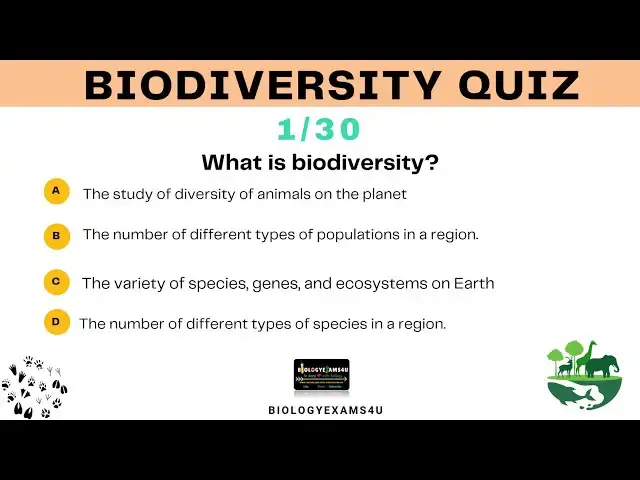
biological science. Question number one,
0:17
what is biodiversity? Options are it is
0:20
a study of diversity of animals on the
0:22
planet. Option B, the number of
0:23
different types of populations in a
0:25
region. Option C, the variety of
0:27
species, genes, and ecosystems on Earth.
0:30
Option D, the number of different types
0:31
of species in a region. You have 10
0:34
seconds to answer this question.
0:43
The correct answer is it is a variety of
0:46
species, genes, and ecosystems on Earth.
0:49
Question number two, which of the
0:51
following is an example of a threatened
0:53
species? Option A, an animal that is
0:56
extinct. Option B, an animal whose
0:58
population is declining and is at the
1:00
risk of extinction. Option C, a plant
1:02
that grows quickly and is found
1:04
everywhere. Option D, an animal whose
1:06
population is declining drastically.
1:16
The correct answer is a threatened
1:18
species is an animal whose population is
1:21
declining and is at the risk of
1:23
extinction. Question number three, the
1:25
loss of biodiversity means option A
1:28
habitat destruction. Option B
1:29
extinction, option C, loss of genetic
1:31
variation. Option D, all of these.
1:40
The correct answer is all of these.
1:42
Question number four, what is a hot spot
1:45
of biodiversity? Option A, a place with
1:48
very high temperatures. Option B, an
1:50
area with a large number of endemic
1:51
species that are under threat. Option C,
1:54
a popular tourist destination with rich
1:56
biodiversity. Option D, a very high
1:59
temperature region with many endemic
2:01
species under threat.
2:10
The correct answer is hotspot is an area
2:13
with a large number of endemic species
2:15
that are under threat. Question number
2:18
five, what is the main cause of
2:20
biodiversity loss today? Option A,
2:22
natural disasters like earthquakes and
2:24
floods. Option B, habitat destruction
2:27
and fragmentation. Option C, pollution
2:29
and industrialization. Option D, climate
2:32
change.
2:40
The correct answer is habitat
2:42
destruction and fragmentation.
2:46
Question number six, what does endemic
2:48
species mean? Option A, species that can
2:51
live in many different environments.
2:53
Option B, a species often present at the
2:55
core zone of an ecosystem. Option C, a
2:58
species that is very rare worldwide.
3:00
Option B, a species that is only found
3:03
in one specific geographic area.
3:13
The answer is endemic species is a
3:15
species that is only found in one
3:18
specific geographic area. Panda is
3:20
endemic to China. Kangaroo is endemic to
3:23
Australia.
3:25
Question number seven. Which type of
3:27
diversity refers to the variety of genes
3:30
within a species? Option A, species
3:32
diversity. Option B ecosystem diversity.
3:35
Option C genetic diversity. Option D
3:37
generic diversity.
3:46
Correct answer is genetic diversity.
3:49
Question number eight. Why is
3:51
biodiversity important for ecosystems?
3:54
Option A. It makes ecosystems stable but
3:57
weak. Option B, makes ecosystem stable
4:00
and resilient. Option C, it has no
4:02
effect on ecosystem health. Option D, it
4:04
only benefits a few select species.
4:15
The correct answer is it makes
4:17
ecosystems stable and resilient.
4:20
Question number nine, what is a keystone
4:22
species? Option A, species that is
4:24
important to an ecosystem. Option B, a
4:27
species whose removal has a
4:29
disproportionately large effect on its
4:31
ecosystem. Option C, a species that is a
4:34
predator at the top of the food chain.
4:36
Option D, a plant species that is a
4:38
primary producer.
4:48
The answer is a species whose removal
4:50
has a dis disproportionately large
4:52
effect on its ecosystem. Keystone
4:54
species include tiger, elephant in
4:57
grasslands, etc. Question number 10,
5:00
what is conservation biology? Option A,
5:02
the scientific study of climate change
5:04
and its impact on biodiversity
5:06
conservation. Option B, the scientific
5:08
study of conservation of natural
5:10
resources. Option C, the scientific
5:12
study of the nature and status of its
5:14
biodiversity within the aim of
5:17
protecting it. Option D, the study of
5:19
all ecosystems.
5:27
The correct answer is conservation
5:29
biology is a scientific study of the
5:31
nature and status of Earth's
5:33
biodiversity with an aim of protecting
5:36
it. Question number 11. The sixth mass
5:39
extinction is primarily driven by which
5:41
factor? Option A, asteroid impact and
5:44
pollution. Option B, climate change and
5:46
invasive species. Option C, human
5:48
activities. Option D, natural geological
5:51
processes.
5:59
The answer is human activities. Question
6:02
number 12. What is the difference
6:04
between XC2 and INC2 conservation?
6:06
Option A. Exit conservation is for
6:08
plants, institute for animals. Option B,
6:10
exit conserves species in their natural
6:12
habitat while INC2 conserves them
6:15
outside their natural habitat. Option C,
6:17
INC2 conserves species in their natural
6:20
habitat while exit conserves them
6:21
outside their natural habitat. Option D,
6:24
exit is for marine species whereas initu
6:26
is for terrestrial species.
6:36
The correct answer is institute
6:38
conservation
6:40
of species is within their natural
6:42
habitat that means inside the natural
6:44
habitat whereas exit it is external or
6:48
conserves them outside the natural
6:50
habitat. Question number 13. The concept
6:53
of ecosystem surfaces means option A the
6:56
jobs created by the tourism and
6:57
ecosystem based industries. Option B,
7:00
the direct financial value of natural
7:02
resources. Option C, the benefits that
7:04
humans receive from ecosystems. Option
7:07
D, the legal framework for environmental
7:09
production.
7:17
The correct answer is ecosystem services
7:20
means the benefits that humans receive
7:22
from ecosystems. Question number 14. A
7:25
biome is best described as option A. a
7:28
specific local habitat with rich
7:30
biodiversity. Option B, group of
7:32
organisms interacting with each other
7:33
and with their environment. Option C, a
7:36
large geographic region of plants and
7:38
animals characterized by the dominant
7:40
plant type. Option D, a large geographic
7:42
region of plants and animals
7:44
characterized by the dominant predator
7:46
animal.
7:55
The correct answer is a large geographic
7:57
region of plants and animals
7:59
characterized by the dominant plant
8:01
type. Question number 15. What is a term
8:04
for a species introduced to a new
8:06
environment that causes harm to the
8:07
native species and ecosystem? Option A,
8:10
endomic species. Option B, founder
8:12
species. Option C, pioneer species.
8:14
Option D, invasive species.
8:25
The correct answer is invasive species.
8:27
Question number 16. Which of the
8:29
following is a primary threat to the
8:31
coral reef destruction? Option A,
8:33
pollution and microplastic pollution.
8:35
Option B, climate change and ocean
8:37
acidification. Option C, coastal
8:39
development. Option D, alkali blooms.
8:49
The correct answer is ocean
8:51
acidification caused by increased carbon
8:53
dioxide absorption and climate change.
8:57
Question number 17. A trophic cascade is
9:00
a phenomenon where option A, nutrients
9:02
flow from the soil to the plants. Option
9:04
B, the removal of top predator causes
9:06
change in the population of other
9:07
species at different trophic levels.
9:10
Option C, different species share the
9:12
same food resource. Option D, a species
9:14
adapts to a new climate.
9:24
The correct answer is the removal of a
9:25
top predator causes changes in the
9:27
population of other species at different
9:29
trophic levels. Question number 18, what
9:32
is the edge effect in biodiversity?
9:35
Option A, the gradual change in species
9:37
composition as you move from the core of
9:39
the habitat to its edge. Option B, the
9:42
increase in species diversity at the
9:44
center of the habitat. Option C, the
9:46
complete loss of biodiversity at the
9:48
edge of a habitat. Option D, the
9:50
protective barrier created by a
9:53
habitat's edge.
9:59
The correct answer is the gradual change
10:01
in species composition as you move from
10:03
the core of a habitat to its edge.
10:06
Question number 19. The Millennium
10:08
Ecosystem Assessment, MEA, categorized
10:10
ecosystem services into which four main
10:13
types. Option A, provisioning,
10:15
supporting, regulating, and cultural.
10:17
Option B, economic, social,
10:19
environmental, and political. Option C,
10:21
aesthetic, recreational, educational and
10:23
spiritual. Option B, food, water, air
10:26
and shelter.
10:32
The correct answer is provisioning,
10:34
supporting, regulating and cultural.
10:37
Question number 20. What is a
10:39
biodiversity index like the Shannon
10:41
winner index? Option A, measure of total
10:44
number of individuals in an ecosystem.
10:46
Option B, a single number that
10:47
represents the diversity of species in a
10:49
community taking into account both
10:51
species richness and evenness. Option C,
10:53
a way to calculate the age of a habitat.
10:56
Option D, a list of all species found in
10:59
a particular area.
11:07
The correct answer is a single number
11:08
that represents the diversity of species
11:10
in a community taking into account both
11:13
species richness and evenness. Question
11:15
number 21. The concept of a biodiversity
11:17
offset is designed to achieve what?
11:20
Option A, to create new habitats without
11:23
any environmental impact. Option B to
11:25
compensate for unavoidable biodiversity
11:28
loss by achieving measurable
11:30
conservation outcomes elsewhere. Option
11:32
C to prevent all human development if it
11:35
disturbs ecosystem. Option D to find
11:38
companies that damage the environment.
11:50
The correct answer is biodiversity
11:52
offset is to compensate for unavoidable
11:55
biodiversity loss by achieving
11:57
measurable conservation outcomes
11:59
elsewhere? Question number 22. Which
12:02
principle states that the genetic
12:04
diversity of a species is higher near
12:06
the equator and decreases towards the
12:09
ports? Option A, the latitudinal
12:11
biodiversity gradient. Option B, the
12:13
island biogeography theory. Option C,
12:15
the longitudinal biodiversity gradient.
12:17
Option D, the principle of competitive
12:20
exclusion.
12:26
The correct answer is the latitudinal
12:29
biodiversity gradient. Question number
12:31
23. The Ali effect is a phenomenon where
12:34
option A, a species growth rate
12:36
increases with a decrease in population
12:38
density. Option B, individuals of a
12:40
species cooperate at low population
12:42
densities leading to a positive
12:44
correlation between population size and
12:46
growth rate. Option C, competition
12:48
between species leads to exclusion of
12:51
one. Option D, population growth is
12:53
limited by a single resource.
13:02
The correct answer is individuals of a
13:04
species cooperate at low population
13:06
densities leading to a positive
13:08
correlation between population size and
13:10
growth rate. Question number 24, what is
13:13
biorrosspecting? Option A, the illegal
13:15
harvesting of endangered species. Option
13:18
B, the exploration of natural resources
13:20
for commercially valuable compounds,
13:22
genes or products. Option C, the legal
13:24
harvesting of endangered species for
13:26
commercial use. Option D, the process of
13:29
reintroducing a species into the Y.
13:39
The correct answer is the exploration of
13:42
natural resources for commercially
13:44
valuable compounds, genes, and products.
13:47
Question number 25. An independent
13:49
intergovernmental body established in
13:52
2012 to provide policy makers with
13:54
objective evidence-based scientific
13:56
assessments on the global and regional
13:59
biodiversity ecosystems and their vital
14:01
services to people is option A MAB,
14:05
option B IPCC, option C UNCC, option D
14:09
IPES.
14:18
The correct answer is IPBES,
14:20
Intergovernmental Science Policy
14:22
Platform on Biodiversity and Ecosystem
14:25
Services. Question number 26, what is
14:28
cryptic speciation? Option A, the
14:30
process of a species going extinct
14:32
without being discovered. Option B, the
14:34
existence of two or more species that
14:35
are morphologically identical but
14:37
reproductively isolated and genetically
14:39
distinct. Option C, the formation of a
14:42
new species through hybridization.
14:43
Option sudden appearance of a new
14:45
species in the fossil record.
14:53
The correct answer is cryptic species is
14:55
the existence of two or more species
14:57
that are morphologically identical but
14:59
reproductively isolated and genetically
15:02
distinct. Question number 27. The
15:04
concept of niche partitioning helps to
15:06
explain how species can live in same
15:09
area without direct competition. Option
15:11
B. A single species can occupy multiple
15:13
habitats. Option C, a keystone species
15:16
controls an ecosystem. Option D, an
15:19
invasive species out competes a native
15:22
one.
15:27
The correct answer is species can live
15:30
in the same area without direct
15:32
competition. Question number 28. What is
15:35
the primary focus of the CBD or
15:38
convention on biological diversity?
15:41
Option A to establish global parks and
15:43
wildlife sanctuaries for biodiversity
15:45
protection. Option B, the conservation
15:47
of biological diversity, the sustainable
15:49
use of its components and the fair and
15:51
equitable sharing of benefits arising
15:52
from genetic resources. Option C, the
15:55
conservation of endangered species and
15:57
its international trade regulations.
15:59
Option D to conserve fund scientific
16:01
research on new species and conservation
16:04
of endangered species.
16:14
The answer is the conservation of
16:15
biological diversity, the sustainable
16:17
use of its components and the fair and
16:19
equitable sharing of benefits arising
16:21
from genetic resources. Question number
16:24
29. The insurance hypothesis of
16:26
biodiversity suggests that option A that
16:29
ecosystem with higher biodiversity are
16:31
more resilient and stable against
16:33
environmental changes. Option B that
16:35
ensuring species against extinction is a
16:37
cost effective conservation strategy.
16:39
Option C that biodiversity is directly
16:41
proportional to economic growth. Option
16:43
D that species diversity is a random
16:45
occurrence stabilized by environment.
16:56
The correct answer is insurance
16:58
hypothesis states that ecosystem with
17:00
higher biodiversity are more resilient
17:02
and stable against environmental
17:04
changes. And the final question, what is
17:06
meta population dynamics? Option A, the
17:09
study of population growth in a single
17:10
isolated habitat. Option B, the study of
17:13
how a group of specially separated
17:15
populations of the same species interact
17:17
with individuals moving among them.
17:20
Option C, the study of relationship
17:21
between a predator and its prey
17:23
population. Option D, the study of how
17:25
different populations of the same
17:27
species interact within an ecosystem.
17:38
The answer is metapopul dynamics is a
17:41
study of how a group of spatially
17:43
disperated populations of the same
17:44
species interact with individuals moving
17:46
among them.
17:48
Hope you are benefited from this use. We
17:51
have given many videos on environmental
17:53
science. You can watch that for more.
17:56
Comment your score below. Take care.
17:58
Stay blessed. Thank you so much. You are
17:59
with biologics for you.com.