0:00
Hi friends, in this video we have an
0:01
interesting topic that is sex
0:03
determination in plants. Do plants have
0:06
sex determination as in humans, the XY
0:09
mechanism or some other mechanisms?
0:11
So, this is a classical study that was
0:13
conducted during the '50s
0:16
considered as a crucial milestone in the
0:19
study of plant genetics. And we'll be
0:22
discussing this within 5 to 10 minutes.
0:25
The study was conducted by team of
0:28
under the leadership of Warmke and
0:30
Westergaard in the 1950s. The plant was
0:33
Melandrium album. First, let us
0:35
summarize their findings before moving
0:40
Plant is dioecious. That means there is
0:42
a male plant and a female plant.
0:45
They found out that in this plant there
0:47
is an active Y chromosome just as in
0:53
The diploid number of plant is 24.
0:55
The other synonym of this plant is
0:58
Silene latifolia. At that time it was
1:00
called Melandrium album.
1:03
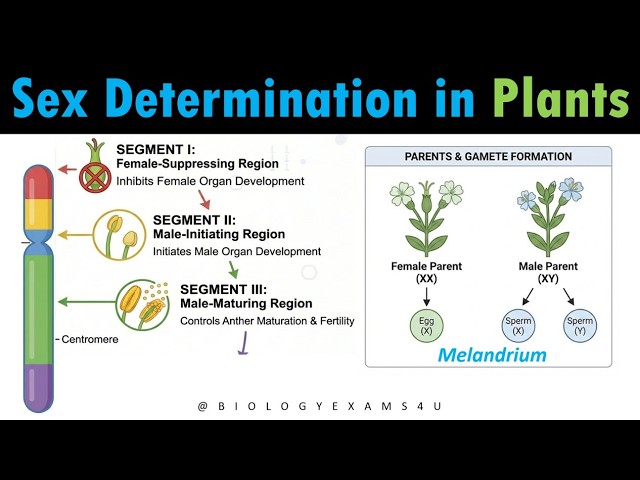
So, this is the female plant just like
1:06
humans, it is XX whereas male plant is
1:09
XY. Female plant is homogametic. It
1:12
produces one type of gamete, that is X
1:14
gamete. Whereas male plant is
1:16
heterogametic, produces X and Y sperms.
1:20
And the offsprings are produced in equal
1:23
number, that is 50% will be female and
1:30
Now, let us see how this works. And they
1:32
found out that the Y chromosome
1:35
in Melandrium is significantly larger
1:39
compared to the X chromosome.
1:43
And they identified specific regions on
1:46
Y chromosome and X chromosomes that
1:49
actually determines the sex of the
1:51
plant. The chromosome is submetacentric.
1:54
A short P arm and a long Q arm. The
1:57
first region or first segment contains
2:01
that suppresses female development
2:04
or inhibits female organ development.
2:08
The second region on the Y chromosome
2:10
is a male initiating region
2:13
or that initiates male reproductive
2:16
organ development. And the third region
2:19
in the Q arm is the male maturing
2:21
region. It controls anther maturation
2:25
And the fourth region is a segment four,
2:27
which is a homologous region that pairs
2:30
during meiosis with the X chromosome.
2:34
So, these are the four regions they
2:35
identified on the Y chromosome of
2:41
Whereas in X chromosome, there is an
2:42
homologous region, a pseudoautosomal
2:44
region that pairs with Y chromosome
2:49
Then, there is an X specific region,
2:52
that is a female promoting region that
2:54
contains genes that promotes the
2:56
development of gynoecium.
2:58
So, these are the regions on X
3:00
chromosome. As we mentioned, X
3:02
chromosome is smaller compared to Y
3:07
Now, let us see how these regions
3:09
affects the development or determines
3:12
the sex of the plant. First case, as you
3:15
see, this is Y chromosome which is
3:17
intact and X chromosome.
3:20
So, Y chromosome, the segment one will
3:25
the production of female reproductive
3:27
structure. So, this is a normal male
3:33
The stamens develop and mature as all
3:35
four segments in the Y chromosome is
3:39
And this is a normal female. There is no
3:41
Y chromosome. There is only X chromosome
3:44
or XX. So, the segment in the X specific
3:47
genes promote the gynoecium development
3:50
or carpel development. And this is the
3:54
And they did certain mutations to find
3:56
out the functions of each regions. And
3:59
in the third case they mutated the first
4:03
segment. As we know, this first segment
4:08
in suppressing female reproductive
4:13
The genes in the first segment is
4:15
involved in suppressing
4:17
the formation of female reproductive
4:19
system. So, this is deleted so that
4:22
there won't be any suppression.
4:24
Gynoecium or carpel grows along with
4:27
stamens. Therefore, the plant will be
4:30
bisexual or hermaphrodite.
4:33
This is how they identified that the
4:36
first segment or genes in the first
4:38
segment is actually inhibiting the
4:41
growth of the female reproductive
4:43
structure or gynoecium.
4:45
And the final case is the second region.
4:47
They mutated the second region. As we
4:49
know, the second region is involved
4:53
in the formation of male reproductive
4:55
structure or male initiating region. So,
4:58
second region is mutated. First region
5:01
is active, that will suppress the
5:04
formation of carpel. Second region is
5:08
suppressed or mutated, that will inhibit
5:11
the formation of male reproductive
5:14
structure or anthers. Then the flower
5:16
will be asexual without anthers or
5:21
That lead to asexual flowers.
5:24
And they found out that this Y
5:25
chromosome is actually determining the
5:27
sex of the plant in Melandrium.
5:30
Further, they found out that there is a
5:32
dominance of Y chromosome even in
5:34
polyploids. And this is a female
5:36
>> autosomes and X chromosomes.
5:39
They showed that Y chromosome is so
5:40
dominant that even in polyploids, as you
5:43
see, the presence of a single Y
5:45
chromosome will make it
5:48
male even in triploid condition
5:51
or polyploid condition.
5:54
But later, hermaphrodites in extreme
5:56
cases, if the dosage of four X
5:58
chromosomes presence of four X
6:03
overcomes the single Y chromosome.
6:06
Then the plant become bisexual or
6:10
Hope you are clear. Take care. Stay
6:12
blessed. Thank you so much. You are with