0:00
do you ever wonder how a single cell can become a complex organism like a human being or a blue whale
0:06
the answer lies in the different levels of organization of life from the smallest atom
0:12
to the largest ecosystem all living things are organized in a hierarchical fashion hi friends
0:19
welcome to biology exams4u.com in this video let us understand 12 levels of organization of life
0:26
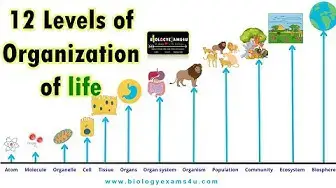
within five minutes. Let's begin with atom. Atoms are the basic building blocks of matter composed
0:33
of subatomic particles like protons, neutrons and electrons. Atoms combines to form molecules. Here
0:41
you can see two oxygen atoms are bonded to form oxygen molecule or O2. These molecules combined
0:49
in different combinations to form the biomolecules like carbohydrates, proteins, lipids and nucleic
0:55
acids or grouping or aggregates of biomolecules within a membrane with a function inside cell
1:02
forms the organelles or subcellular particles that is present in within a cell with a specified
1:09
function like mitochondria that is involved in ATP synthesis or energy synthesis, chloroplast
1:15
that is involved in photosynthesis like that. Then the next level of organization is a basic
1:22
unit of life which is called the cell which is capable of carrying out all the basic functions of life like growth reproduction etc Cell is the smallest unit capable of sustaining life
1:36
These cells or group of cells of the same kind that perform same function forms the tissues
1:44
like epithelial tissue, nervous tissue or neurons, etc. group of tissues working together performing a specific function forms the organ like this stomach
1:56
kidney liver brain etc then the next level is the grouping of these organs that work together to
2:04
perform certain functions that forms organ systems like this digestive system respiratory system
2:12
muscular system etc. These systems works together to make an individual organism
2:20
This organ systems combines and works in tandem to perform different life functions like metabolism
2:26
growth, reproduction etc. Organisms includes plants, animals, bacteria etc. Take the case of
2:34
a pride of lion that is living in a particular area that forms a population
2:41
organisms of a same species that live in a same area then group of populations
2:48
that lion population, the zebra population, the hyena population all together group of populations that interact with each other or live in the same area makes up a community The next level is the ecosystem where the communities of organisms interacts with one
3:06
another and also with their environment. So this is a grassland ecosystem where lion, tiger, hyena
3:12
buffalo and all the plants that is interacting with each other and also interacting with the
3:18
environment that forms the ecosystem. Ecosystems include grasslands, desert, tundra, taiga etc
3:26
And finally, this ecosystem combines together to form the biosphere, the part of earth where life
3:34
exists made up of biomes, a combination of all ecosystems on this planet that is inhabited by
3:42
living things including plants, animals, bacteria etc. Remember each level of organization is
3:50
dependent on the levels below it like this cell cannot function without these organelles or this
3:57
organism cannot function without these organ systems. Hope you are clear. So why we learn
4:04
this level of organization? This level of organization provide a framework for understanding
4:10
the complexity of life. It also helps us to understand how living things function and interact
4:17
with each other Let me summarize Atom is a basic unit of matter Atom combines to form molecules molecules that forms macromolecules like carbohydrates proteins etc that is surrounded by a membrane forms organelles the subcellular
4:32
structures that is present within the cell then the cell the basic unit of
4:37
life the smallest unit of life with many organelles inside capable of growth
4:43
reproduction etc then cells of the same type performing same function forms
4:49
tissues. Then tissues, different tissues, multiple tissues combine together to form organs like
4:55
stomach. Then these organs works in tandem, combines together to form organ systems
5:01
performing functions like digestion or digestive system, reproductive system, etc. Then finally
5:07
forming an organism with many organ systems that works together, performing different life functions
5:14
like metabolism, growth, reproduction, etc. like this lion, then this group of lion that is living
5:21
in a specific area that forms the population, different populations that is in a specific area
5:27
like lion, zebra, wild beast, etc. all together makes a community and many communities that is
5:35
interacting with one another and also with the environment forms the ecosystem like this grassland
5:40
ecosystem. And finally, in all the regions where life exists, forms the biosphere, a combination of
5:47
all ecosystem on this planet. Take care. Stay blessed. Thank you so much for your support