0:00
In insulin receptor signaling, the
0:02
activation of insulin receptor triggers
0:05
a dual pathway. Upon activation, this
0:08
insulin receptor mediates two pathways.
0:11
A dual pathway. The first one is the
0:14
metabolic response that is mediated by
0:17
IRS or insulin receptor substrates that
0:20
controls glucose uptake, storage and
0:22
metabolism mediated by PI3 Kakt pathway.
0:26
The second one is a mitogenic response
0:29
that is mediated by SC or IRS. The
0:32
classical RAS map K pathway that
0:35
regulates cell growth proliferation and
0:39
In this video we'll be discussing IR
0:41
mediated metabolic pathway and glute for
0:43
transllocation. A stepwise explanation
0:47
for better understanding then IR
0:49
mediated mitogenic pathway. insulin
0:52
resistance and how this mitogenic
0:54
pathway leads to chronic diseases and
0:57
what are our therapeutic colds and
0:59
promising drug candidates. Let's begin
1:02
with IR metabolic pathway or it's also
1:04
called as PI3 AK pathway. So let's break
1:08
down this entire pathway into simple
1:11
steps for better understanding. Pathway
1:13
is responsible for glucose, lipid and
1:15
protein management, their storage and
1:19
Upon activation of this insulin receptor
1:21
by the binding of insulin
1:23
this IRS insulin receptor substrates
1:27
they are crucial adapter proteins.
1:30
They're family of proteins that acts as
1:32
central hub or docking sides to activate
1:36
downstream pathway that is involved in
1:38
primarily involved in metabolism of
1:40
glucose. This activated insulin receptor
1:43
phosphorates IRS specific tyrosin
1:46
residues on IRS proteins especially IRS1
1:54
This is followed by step one PI3K
1:58
phosphorolated or activated insulin
2:00
receptor substrates recruits and
2:04
which is phosphoetide
2:12
3 kynise in step two causes lipid
2:19
which is a membrane lipid is converted
2:22
to PIP3. So this is mediated by or
2:28
In step three, this PIP3 causes kynise
2:32
recruitment. It pulls two proteins PDK1
2:36
and AKT. Both are protein kinases that
2:38
can phosphorolate many other proteins to
2:44
This is followed by further activation
2:46
of AKT by PDK1. PDK1 phosphorates AKT
2:52
making it fully active to move
2:54
throughout the cell. Now the signal is
2:56
completely running. The negative
3:00
feedback regulator is beaten that is
3:03
actually defosphorulating this PIP3 thus
3:06
inhibiting the signal acts as a break or
3:10
regulate the signal after the metabolic
3:12
task is complete. So AKT is activated.
3:16
It is phosphorolated. AKT is activated.
3:19
Now step five is the most important step
3:22
that is the glucose uptake stimulates
3:25
glute for transllocation to the plasma
3:27
membrane is also associated with
3:30
glycogen synthesis inhibits GSK3 to
3:33
promote sugar storage. Then protein
3:36
synthesis activates MTOR and
3:38
gluconneioenesis inhibition
3:40
phosphorilates fox transcription factors
3:42
to prevent the liver for from making
3:44
excess sugar as the sugar is going to
3:46
enter into the cell. Now let us see in
3:49
detail the step five that is glucose
3:52
uptake by glute for transllocation.
3:56
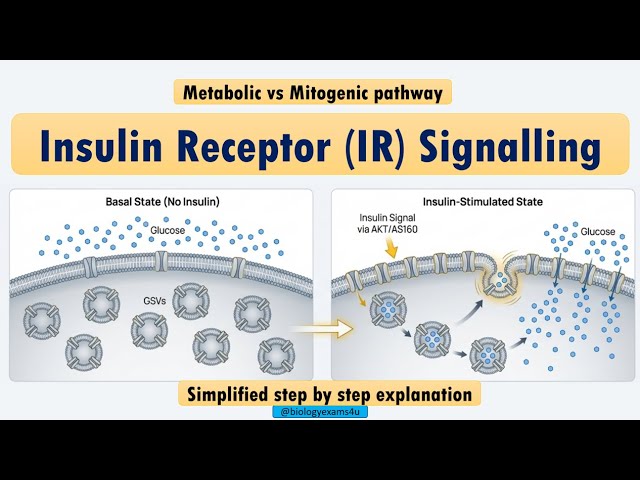
So step five is a glucose uptake that
3:57
stimulates glute for transllocation to
3:59
the plasma membrane. So this is glucose
4:01
that is present outside the cell.
4:03
Glucose cannot enter the cell. It is not
4:06
permeable. It can enter the cell only
4:08
through this glute for transporters or
4:11
transmembrane channels.
4:14
In muscles and fat cells, majority of
4:16
glute 4 are held in intracellular
4:18
vesicles as you see here. And this is
4:21
called glute for storage vicles. So they
4:23
are locked as vesicles in the cytoplasm.
4:26
If glucose is not present or basil state
4:29
whether where there is no insulin.
4:32
The next step is activated AKT
4:35
phosphorilates a substrate called as
4:39
and this further activates a small GTPSS
4:44
which is a protein that is involved in
4:46
exocytosis of glute for storage
4:49
vesicles. So let us make it more clear.
4:52
So this is the vesicle with glute for
4:55
transporters and activation of the
4:57
signal or aktas 1 160 activation causes
5:01
the movement of this vesicles to the
5:03
plasma membrane and this vesicles fuses
5:06
with the plasma membrane and this glute
5:10
for transporters are embedded into the
5:12
plasma membrane. Now as you see from the
5:14
basil state to the insulin stimulated
5:17
state more glute for transporters are
5:20
loaded into the plasma membrane and that
5:24
actually enhances the glucose uptake
5:26
into the cell. So GSV fuses and embedded
5:30
glute for so there are many glute for
5:32
now in the plasma membrane that enhances
5:35
the ability of the cell to take up
5:38
So this is actually what is happening in
5:40
metabolic pathway. So if this pathway is
5:44
impaired or if there is any problem with
5:48
the glucose will remain outside the
5:50
glucose level in the bloodstream
5:53
which is often called as insulin
5:55
resistance. Hope this is clear. Now let
5:58
us move into the mitogenic pathway.
6:01
Mogenic pathway is often activated at
6:03
high concentration compared to this
6:04
metabolic pathway. So this is the
6:07
mitogenic pathway. This is a classical
6:11
that is responsible for cell
6:12
proliferation, survival and
6:14
differentiation. As we know that insulin
6:16
is a growth hormone also apart from a
6:20
hormone that is involved in metabolism
6:22
of glucose. So upon activation of
6:24
insulin receptor another protein that is
6:27
primarily involved in cro signal that is
6:29
SHC is recruited that is phosphorolated
6:34
phosphorilated SC that acts as an
6:37
adapter recruits another protein which
6:45
that's a step one step two RAS
6:47
activation SOS triggers RAS to exchange
6:49
GDP for GTP that is a classical pathway
6:55
and further pathway downstream. And this
6:57
Ras causes kynes cascade activated Ras
7:01
triggers phosphorilation of Rafmech and
7:06
The classical Raf pathway and signal
7:09
pathway is on. Now finally this
7:15
activated phosphorilated moves into the
7:19
and causes transcription of genes
7:23
that allows or that promotes cell
7:25
division differentiation and survival
7:29
like transcription factors like CIC and
7:31
C force enhances the transcription of
7:33
genes involved in cell division
7:35
migration and also inhibits genes that
7:37
is involved in apoptosis or program cell
7:40
death. So this is the mitogenic signal
7:42
miogenic pathway mediated by insulin
7:45
receptor. Hope you are clear. Now let us
7:48
see how this mitogenic pathway is
7:50
associated with many chronic diseases.
7:54
So this miogenic response is a
7:56
double-edged sword. Suppose this insulin
7:59
receptor has uh some malfunctions or
8:02
downstream pathway is impaired so that
8:04
the signal cannot convey so that this
8:07
pathway this metabolic pathway is
8:09
blocked so that outside the insulin
8:13
concentration rises in the bloodstream.
8:16
This generally activates this mitogenic
8:19
pathway. So this pathway is on that but
8:22
lead to growth and cell division often
8:25
leading to inflammation because of this
8:27
insulin resistance. This is called
8:29
insulin resistance as the glucose cannot
8:32
be metabolized due to the problem with
8:34
the receptor or downstream pathways and
8:37
an unchecked mitogenic pathway is
8:39
happening that lead to many diseases
8:41
like cardiovascular diseases that leads
8:44
to atherogenic dysipidemia
8:47
that means high VLDL low HDL which is a
8:51
good cholesterol and high LDL these high
8:56
VLDL and LDL is atherogenic that can
8:59
cause fatty deposits in the arteries
9:02
leading to major cardiovascular diseases
9:06
or plagues plague deposition.
9:10
Then neurodeeneration is also the reason
9:12
of this activation of the smoggenic
9:14
pathway brain insulin resistance impas
9:17
neuron survival leads to stimulation of
9:18
GSK3 beta which causes
9:21
hyperphosphorilation of tow proteins
9:24
and enhances amoid beta plate
9:27
deposition. the primary reason for
9:29
Alzheimer's. It can of course cause
9:32
cancer. Unchecked MAK signaling and high
9:34
levels of IGF can accelerate the growth
9:36
of neoplasms andiogenesis and metastasis
9:40
in cancers of the breast, colon, liver
9:42
and pancreas. So unchecked mgenic
9:46
pathway activation can lead to many
9:49
chronic diseases associated with insulin
9:52
receptor and insulin receptor mediated
9:54
pathway. So our therapeutic goal is to
9:58
device or a drug that is an agonist that
10:02
is biased towards the metabolic pathway
10:05
or restoring this metabolic pathway
10:08
whereas without interfering with this
10:10
mitogenic pathway or unfounded growth
10:13
signals are avoided.
10:15
There are some promising candidates
10:18
research is going on. First one is
10:19
peptide S596 a synthetic peptide shown
10:23
to selectively activate AKT over uh AKT
10:27
over this ERK pathway. The second one is
10:30
XMET A which is a human monoconal
10:33
antibbody that acts as an alosteric
10:35
activator of the IR improving glycemic
10:38
control with a varable signal profile.
10:40
The research is going on the research is
10:42
going on regarding its further efficacy
10:46
and safety. Hope you understand the
10:49
pathway that is mediated by insulin
10:51
receptor. The two pathways. The first
10:53
one is the metabolic pathway where
10:56
glucose metabolism happens and the
10:59
second one is a mitogenic pathway that
11:01
leads to cell division and growth. Hope
11:04
you are benefited from this video. Take
11:06
care. Stay blessed. Thank you so much.
11:08
You are with biologics4.com.