0:00
Hi friends, in this video let us
0:01
understand the genic balance theory
0:04
proposed by Calvin Bridges regarding the
0:06
sex determination in Drosophila.
0:09
Let's begin with the background for
0:10
better understanding. While working in
0:12
Drosophila, Calvin Bridges found out
0:14
that the genotype XX is the genotype and
0:18
the phenotype is female in Drosophila.
0:21
Whereas XY is male just like humans. But
0:25
later studies found out that the Y
0:27
chromosome does not determine sex. Or in
0:31
other words, XXY, even though presence
0:34
of Y is there, it is female. Y has no
0:37
role in determining the sex. Whereas XO,
0:40
without a Y chromosome,
0:43
a single X will make the phenotype male.
0:46
So, if you remove the Y chromosome, the
0:48
fly is still male. If you add a Y
0:51
chromosome to the female, that is XXY,
0:53
the fly is still female. That means Y
0:56
chromosome does not determine sex.
0:59
And this finding actually lead to
1:02
further research that lead to the
1:04
discovery of genic balance theory. It
1:06
was proposed by Calvin Bridges in 1921.
1:09
And this was a summary of the findings.
1:12
Autosomes are responsible for male-ness,
1:15
whereas female-ness is determined by the
1:18
X chromosome. He observed that Y
1:20
chromosome in Drosophila does not
1:22
determine sex. It is only required for
1:24
male fertility. Sex is determined by the
1:27
balance between female determining
1:29
factors on the X chromosome and male
1:32
determining factors on the autosomes.
1:35
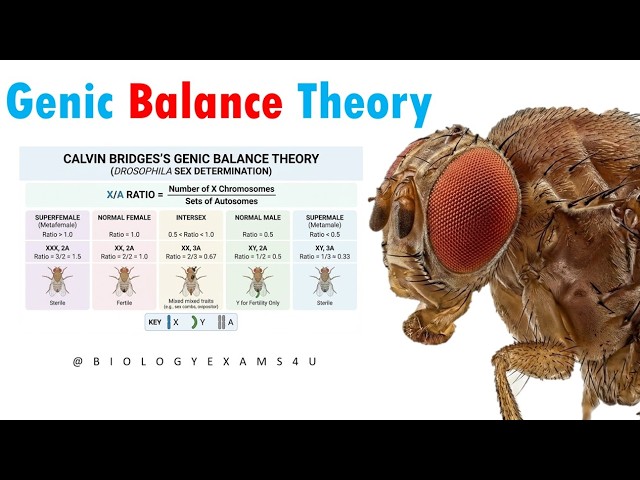
And he formulated a ratio, a fundamental
1:37
ratio, which is called as sex index
1:39
ratio. That is X by A ratio, where
1:43
that is equal to number of X chromosomes
1:46
by sets of autosomes. Let us understand
1:49
this theory with the classical
1:51
experimental example of Calvin Bridges.
1:55
His experiment was on Drosophila.
1:57
He used polyploid flies and categorized
2:00
the results based on specific ratios.
2:04
And he used this ratio, that is number
2:06
of X chromosomes by sets of autosomes.
2:10
First, let us see the female. In
2:12
females, there are two X chromosomes.
2:14
Therefore, number of X chromosome is
2:16
two. Whereas sets of autosomes, two
2:19
sets. It's diploid, it's diploid,
2:21
therefore two sets of autosomes. Two by
2:23
two, one. If the ratio is one, it will
2:30
that is XY, there is only one X
2:33
chromosome and two sets of autosomes,
2:35
that is one by two. That is 0.5. If the
2:39
ratio is 0.5, the phenotype is normal
2:42
male. Then he further studied and found
2:45
out many ratios in between. Let us see.
2:48
There are three X chromosomes.
2:50
That is three by two, two or sets of
2:55
Then three by two, it will be 1.5. If
2:58
the ratio is greater than one, it will
3:01
be super female. And this is sterile
3:03
also. If there are three sets of
3:09
there is only one X chromosome and three
3:11
sets of autosomes, one by three. Then
3:13
the ratio will be 0.33. If the ratio is
3:16
less than 0.5, it will be super male and
3:19
that is sterile also.
3:23
And finally, he found out that
3:25
if there are two X chromosome and three
3:28
sets of autosome, then it will be two by
3:35
That the ratio between 0.5 and 0.1
3:39
will be intersex. That shows mixed
3:42
traits of both males and females. And
3:45
this is the summary of genic balance
3:48
theory. And what is the reason for this
3:50
manifestation? Later studies found out
3:53
that there is a gene which is called as
3:57
which acts as a master switch. It acts
4:00
as a biological calculator that
4:02
interprets the XA ratio and decides
4:05
whether the fly will be male or female.
4:10
In Drosophila, this SXL gene must be on
4:14
for females, whereas it should be off
4:16
for males. Otherwise,
4:19
this will be lethal to both females and
4:21
males. That's why it is called as sex
4:23
lethal genes. In the later video, we'll
4:25
be discussing how SXL gene
4:28
determines the sex of in Drosophila.
4:31
Now, finally, the role of Y is
4:34
fertility, not sex determination. Y
4:37
chromosome contains genes that is
4:39
essential for sperm development and
4:41
motility. That is in XY male, whereas in
4:44
XO male, Y chromosome is absent.
4:47
Therefore, it leads to defective sperm
4:50
without motility that lead to sterility.
4:53
This Y chromosome has genes that codes
4:56
for fertility factors
4:58
that codes for dynein motors that makes
5:01
sperm tails move. So, without Y, the fly
5:04
is male, but it is sterile.
5:07
Hope you are clear. Take care. Stay
5:09
blessed. Thank you so much. You are with