Up next in 10

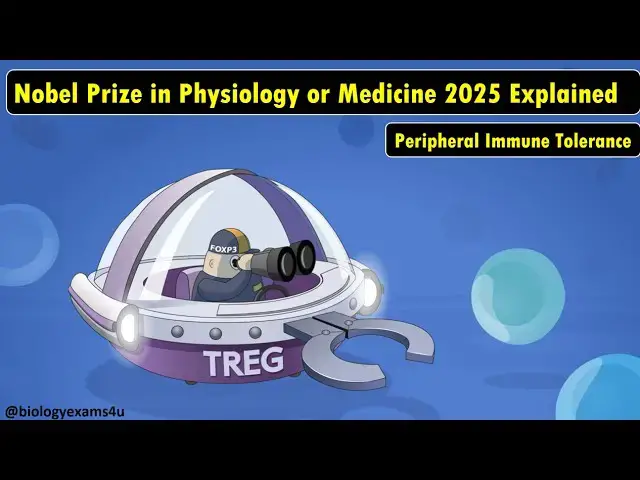
Explained! Nobel Prize in Physiology or Medicine 2025|| How Peripheral Immune Tolerance works?
Oct 11, 2025

10 minute video explaining The Nobel Prize in Physiology or Medicine for 2025 that honors three researchers—Mary E. Brunkow, Fred Ramsdell, and Shimon Sakaguchi—for their revolutionary discoveries concerning peripheral immune tolerance. Their work revealed how the body’s powerful immune system is prevented from attacking its own tissues by identifying the specific cellular “security guards” responsible for this crucial regulation. Their insights have laid the foundation for developing new treatments for cancer and autoimmune diseases.
00:00 Introduction Nobel Prize in Physiology or Medicine for 2025 winners
00:20 Shimon Sakaguchi: The Discovery of Regulatory T Cells
00:35 How T cell works?
01:39 What is central tolerance?
02:50 Sakaguchi experiment 1
04:22 Experiment 2: The Discovery of Regulatory T Cells
05:49 Mary E. Brunkow and Fred Ramsdell: The Discovery of Foxp3 gene
07:37 Human IPEX disease and Scurvy disease
08:33 How Regulatory T Cells protect us?
09:25 Summary What is Peripheral immune tolerance?
10:09 Significance of Nobel Prize 2025
Happy Learning✌️@biologyexams4u
===============================================================
We really appreciate your support 👍
Thank you so much :)
▶Enroll now. Our free certificate course on Introduction to Recombinant DNA Technology
https://alison.com/course/introduction-to-recombinant-dna-technology?utm_source=alison_user&utm_medium=affiliates&utm_campaign=22177687
📙Introduction to Recombinant DNA Technology – Download free E Book
Show More Show Less View Video Transcript
0:00
The Nobel Prize in Physiology or
0:02
Medicine for 2025 honors three
0:04
researchers Mary Ibana, Fred Ramstell,
0:08
and Shyman Saguchi for their
0:10
revolutionary discoveries concerning
0:12
peripheral immune tolerance. This video
0:15
is a humble attempt to explain their
0:18
groundbreaking discovery. First, let's
0:20
begin with Shyman Saguchi's work, the
0:22
discovery of regulatory tea cells or
0:25
TRA. For understanding this we must know
0:28
how T- helpper cells works and what do
0:30
you mean by central tolerance in
0:32
immunology. Let's begin with how T-
0:35
cells works. So this is an infected
0:37
cell. It engulfves the virus by
0:40
fagocytosis
0:42
and degrades it and a partic a fragment
0:45
is presented on MSC receptor or HLA
0:48
protein complex to the outside. So this
0:51
is a particle of the virus that is
0:53
displayed to the outside. So this is
0:56
recognized by T- helpper cells or T-
0:59
cells.
1:01
T- cells as you see there are different
1:02
receptors for T cells or each T- cell
1:05
with is with unique specificity that can
1:08
bind to specific antigenic particles of
1:12
the pathogen. So when a T- cell receptor
1:14
attaches to this virus fragment, this T-
1:17
cell is activated and alerts the immune
1:20
system and triggers a coordinated
1:22
specific immune response against it this
1:25
pathogen by means of all other immune
1:28
cells like B cells, macrofasages etc.
1:31
and finally eliminating the pathogen
1:33
from the system. So T- cells is actually
1:36
regulating this specific immune
1:38
response. Now the second concept that is
1:40
central tolerance. Central tolerance is
1:42
a process where T cells that recognize
1:44
the body own proteins were eliminated
1:47
while maturing in the thymus. Let me
1:49
make it more clear. As we know the cells
1:52
are also produced in bone marrow but
1:54
maturation takes place in thymus.
1:58
During this maturation
2:00
each T- cell has an unique shaped T cell
2:03
receptor on its surface. Then thyus cell
2:06
holds out body zone proteins on a
2:09
receptor to this T- cell. If the T- cell
2:12
recognize body zone or self proteins
2:15
that particular T- cell is destroyed or
2:17
eliminated. This actually prevents
2:20
overreaction or autoimmune response or
2:23
response against self proteins or self
2:26
cells. So this T- cell has to pass this
2:29
test in order to become fully active. So
2:32
T cells that pass this test go out into
2:35
the body to look for intruders or
2:37
pathogens. So this central tolerance is
2:40
very crucial in avoiding overreaction or
2:44
autoimmune response or identification of
2:46
self- proteins or self cells by T cells.
2:50
Now let us understand Sakaguchi's work.
2:52
His hypothesis was that immune system
2:55
must employ some form of security guard
2:58
capable of calming down other T- cells
3:01
that had slipped through the initial
3:03
tolerance test in the thymus. Let us
3:05
understand his hypothesis from his
3:08
experiment. His experiment was he
3:10
removed the thymus from 3-day old mice.
3:15
So this mice developed autoimmune
3:17
disease. As we know thymus is a site of
3:19
maturation of tea cells. immune system
3:22
will be overactive as this T- cells
3:25
don't have that central tolerance or
3:27
that test that eliminate T- cells that
3:30
activate or that interact with self
3:33
cells or self proteins. So immature T-
3:36
cells attack self cells that's why this
3:38
mouse becomes sick. Then he isolated
3:42
mature T- cells from a genetically
3:44
identical mice and injected that T-
3:47
cells into this deceased mice and found
3:50
out that the mice is healthy or this
3:54
injected T- cells protected the mice
3:57
from autoimmune reaction or autoimmune
4:00
disease. These tea cells that is
4:02
injected calm down or check the attack
4:06
by immature T- cells that is already
4:08
present in this mice that is capable of
4:10
attacking self cells. So he concluded
4:13
that there must be a protective cell
4:15
type a security guard that keeps other T
4:17
cells in check or T cells that escape
4:20
this test of central tolerance. This is
4:23
followed by a second experiment that
4:25
discovered regulatory T cells. As we
4:28
know T- helpper cells has CD4 plus
4:31
protein on its surface. So this is a
4:33
typical feature of T- helpper cells. He
4:37
found out another class of T cells which
4:39
is which has this CD4 plus protein.
4:42
Along with that there is CD25 plus
4:45
protein on its surface. Then he
4:47
conducted the same experiment. A mice
4:50
whose thymus is removed. He injected
4:54
T cells only with CD4 plus only or T-
4:59
helpper cells with only CD4 plus protein
5:02
on its surface and found out that mice
5:05
remained sick. Then he continued the
5:07
experiment along with T cells with CD4
5:10
plus protein. He added the cells with
5:13
both receptors CD4 plus and CD25+
5:17
protein on the surface and found out
5:20
that then these cells actually protected
5:23
the mice from developing autoimmune
5:25
response. He identified a new class of
5:28
T- cells. These cells help suppress or
5:31
calm the immune response. they express
5:33
both CD4 plus and CD25 surface proteins
5:38
and he named them as regulatory T- cells
5:40
or TX. So Saguchi
5:44
identified a new class of T cells which
5:46
is called as regulatory T- cells. Now
5:49
the second part of the experiment
5:50
carried out by Mary Mary Branow and Fred
5:54
Ramstl discovery of Fox P3 gene. Mary
5:57
Branow and Fred Ramstl became interested
6:00
in a peculiar mouse train called scurfy
6:02
mouse which originated in the US
6:05
laboratory in the 1940s.
6:07
These are the features of this mouse.
6:10
This male scurfy mice showed fatal
6:12
autoimmune like symptoms.
6:15
Symptoms included scaly skin, enlarged
6:17
organs and early death and there on tea
6:20
cells attacked body tissues. So it's an
6:23
autoimmune response. The mutation
6:26
responsible was located on the X
6:28
chromosome. So they wanted to find out
6:30
the mutant gene that is responsible for
6:33
this curfe condition and they firstly
6:36
carried out the localization. They
6:37
focused on X chromosome. It was known
6:39
that this mutant gene is located on the
6:40
X chromosome.
6:42
So genetic mapping were conducted and
6:45
narrowed down the location of the scurfy
6:47
mutation to an area of 500,000 base
6:50
pairs nucleotides and followed by detail
6:53
mapping an intensive process of mapping
6:55
this large area of DNA in detail. It is
6:58
a herculan task with molecular tools
7:01
available in 1990s. Then gene comparison
7:04
after identifying 20 potential genes in
7:07
that region. They systematically
7:09
compared these genes between healthy
7:11
mice and scurfy mice and finally they
7:15
found out the mutation in the 20th and
7:19
final gene they examined and they called
7:21
it as fox P3 gene. The faulty gene was
7:25
previously unknown but it had
7:27
similarities to a group of genes called
7:29
forut box or fox genes which regulate
7:32
the activity of other genes. So they
7:34
named this new gene as fox p3 gene. Then
7:37
this was the second hypothesis. The
7:39
human connection of this geneex disease
7:42
in humans their hypothesis was it's a
7:46
human variant of scurfy disease. So they
7:49
suspected apex might be the human
7:52
counterpart of scurfy disease. Working
7:54
with pediatricians globally they
7:56
collected samples from boys affected
7:58
with Ipex disease and confirmed that
8:02
harmful mutations existed in the human
8:04
equivalent gene Fox P3. So mutations
8:07
were found in the human fox P3 gene. In
8:10
2001 they confirmed FOX P3 mutations
8:13
cause both Apex and scurfy mouse
8:16
disease. After this discovery, Saguchi
8:19
and others convincingly proved that FOX
8:22
P3 gene controls the development of
8:25
regulatory T cells. So this gene is
8:28
responsible for the development of
8:30
deregulatory cells. So this was the
8:32
experiment. So how this regulatory T
8:35
cells protects us? Suppose a T- cell
8:37
that has slipped through the test in
8:39
thymus. So they can interact with
8:41
proteone proteins that is presented on
8:44
the cell surface. So endogenous protein
8:46
that is presented on HLA receptor. So
8:48
the these T cells can interact as it has
8:51
slipped through the test. So this lead
8:53
to autoimmune reaction then there will
8:56
be an intervention by this petroleum
8:58
regulatory T cells. These T- cells
9:00
discover that the attack is a mistake
9:03
and calm it down. thus preventing
9:06
autoimmune disease. So this is the role
9:08
of deregulatory cells calming down these
9:11
cells that slip through dust in the
9:14
thymus so that it can interact with self
9:16
cells or self- proteins that interaction
9:19
is calmed down by this deregulatory
9:23
cells thus preventing autoimmune
9:25
diseases. The collective discoveries of
9:28
bronco ramstall and sakaguchi explained
9:31
peripheral tolerance. So this is a
9:34
summary. They explain the mechanism for
9:36
peripheral immune tolerance. Regulatory
9:39
T cells or T-Rex maintain peripheral
9:42
immune tolerance. Their development is
9:44
controlled by the FOXP3 gene. TRS act as
9:49
a security guards preventing other T
9:51
cells from attacking the body cells. The
9:54
second role is it also helps in coming
9:57
down the immune system after an invader
9:59
or pathogen is eliminated from the
10:02
system. So overreaction is avoided by
10:05
means of deregulatory cells. So this is
10:07
a summary of their work. Now let us see
10:10
the clinical impact or significance. Why
10:12
these findings fetch the Nobel Prize?
10:14
First, it is widely used in the
10:16
treatment of autoimmune disease.
10:18
Researchers are attempting to promote
10:20
the formation of more regulatory D cells
10:23
using substances like interlucans 2 to
10:26
stimulate deregulatory cell production.
10:29
Another method is by isolating,
10:32
expanding and returning T-Rex to
10:34
patients to prevent autoimmune
10:36
reactions. The goal is to prevent
10:39
autoimmune reactions and also organ
10:41
rejection post transplant. So research
10:44
is going on in this aspect and is based
10:46
on deregulatory cell. The second
10:49
application is in cancer treatment.
10:51
Tumors often attract large number of
10:53
regulatory T cells which protect them
10:56
from immune attacks as a shield.
10:59
Scientists aim to break down this track
11:01
wall so that other immune cells can
11:04
reach and destroy the tumor. So research
11:06
is going on in this aspect also. Their
11:09
works explained peripheral immune
11:12
tolerance that is mediated by
11:14
deregulatory cells. Hope you are
11:16
benefited from this video. Take care.
11:18
Stay blessed. Thank you so much. You are
11:20
with biology exams for.com.