0:00
2023 Nobel Prize in Physiology or Medicine was jointly awarded to Kathleen Carrigo and True Weissman for their discoveries concerning nucleoside-based modifications that enabled the development of effective mRNA vaccines against COVID-19
0:18
This video is a humble attempt to explain this groundbreaking discovery. Their discoveries have actually changed our understanding of how mRNA interacts with our immune system
0:30
and that helps us in developing effective mRNA vaccines at a faster rate against COVID-19 pandemic
0:38
one of the greatest threats to human health in modern times. Let's begin with the background to understand the significance of this discovery
0:48
What was the vaccination strategy before COVID-19 pandemic? As we know vaccination stimulates the formation of an immune response to a
0:57
particular pathogen. This gives the body a head start in fighting a disease in
1:02
the event of a later exposure. The first strategy was we were using killed or
1:10
weakened pathogens as vaccines. When the body is exposed to the real pathogen, the
1:16
immune response will be very quick eliminating the pathogen from the system
1:23
And this method was used in the case of vaccines against polio, measles and yellow fever. Strategy two is recombinant vaccines. With the
1:34
development of recombinant DNA technology, we used the viral genetic cord and this
1:42
cord is isolated and that is transferred into a host like yeast, inside the yeast the genetic
1:50
cord starts producing proteins and we use these proteins or we cultured or we scaled
1:58
up these proteins and used as vaccines Once injected inside the system this will stimulate the formation of virus blocking antibodies Examples include vaccines against
2:10
hepatitis B virus and HPV or human papilloma virus. Mode 3 was we used parts
2:18
of viral genetic code and we incorporated this genetic code into hamless carrier virus as vector. When vector with these genetic code is
2:30
injected as vaccines into our system, then body starts producing proteins that
2:38
stimulates an immune response against the targeted virus and this methodology was adapted in the preparation of vaccines against the Ebola virus. There
2:48
were many limitations associated with these strategies. All these strategies requires large-scale cell culture. This is a resource-intensive process that
3:00
limits the possibilities for rapid vaccine production in the case of a
3:04
pandemic like COVID-19. mRNA vaccines came up as a possible solution. It seems
3:12
promising. By 1980s there were efficient methods for producing mRNA without cell
3:18
culture called in vitro transcription. So the problem of cell culture, large-scale cell culture
3:24
for vaccine production can be eliminated by producing mRNA vaccines. But there were many
3:30
roadblocks for mRNA technology-based vaccines. Like in vitro transcribed mRNAs are unstable
3:39
It is very difficult to deliver this mRNA into a system as sophisticated carrier lipid systems
3:45
to encapsulate this mRNA is needed and finally this in vitro produced mRNA often give rise to
3:54
inflammatory reactions which are undesirable. Now let us see what was the contribution of these
4:01
Nobel laureates Hungarian biochemist Katalin Kariko was devoted to developing methods to use mRNA for therapy but she found it very difficult to convince research funders to pump money into mRNA therapeutics Her colleague at the
4:17
university was immunologist Drew Wiesman. He was interested in dendritic cells that is involved in
4:23
immune surveillance and the activation of vaccine-induced immune responses. And they worked
4:29
together in finding out how different RNA types interact with the immune system. Now let us see
4:35
how they carried out their work. Carigo and Wiesman noticed that dendritic cells recognize
4:42
in vitro transcribed mRNA as a foreign substance which leads to the activation and release of
4:50
undesirable inflammatory signaling molecules. But mRNA from mammalian cells did not give rise to the
4:57
same reaction. They posed the first question, why the in vitro transcribed mRNA was recognized as
5:04
foreign? And they thought that there are some critical properties that distinguish the different
5:10
types of mRNA. They knew that nucleoside bases in RNA from mammalian cells are frequently
5:18
chemically modified while in vitro transcribed mRNA is not chemically modified. And they posed
5:25
the next question. Is the absence of altered bases in the in-vitro transcribed RNA causes
5:32
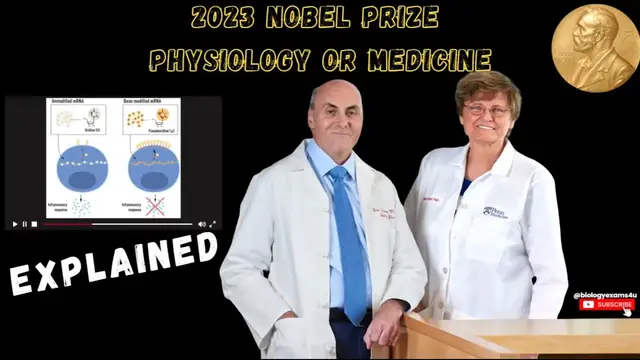
unwanted inflammatory reaction. As you see this unmodified DNA, once inside the cell
5:39
there will be inflammatory response. Amount of protein produced is very low. To investigate this
5:46
they produce different variants of mRNA, each with unique chemical alterations in their bases
5:52
just like this in the place of uridine. This is a base modified mRNA, here it is
5:57
pseudo-uridine and they delivered this base modified mRNA into dendritic cells and the results were striking. The inflammatory response was almost absent
6:10
when base modification were introduced in the mRNA and these results were published in 2005 Later in 2008 and 2010 they further carried out studies by delivering mRNA generated with
6:28
base modifications and found out that these mace modification not only inhibited inflammatory
6:35
response but also increased protein production compared to unmodified mRNA. Thus, their studies
6:42
confirm that base modifications can reduce inflammatory responses and increase protein production thus clearing the major obstacles associated with mRNA-based therapeutics. Later
6:57
many companies attempted mRNA-based modification for vaccine productions to develop vaccines against
7:04
Zika and MERS virus after the outbreak of COVID-19 pandemic. Two nucleoside-based modified mRNA vaccines encoding the SARS-CoV-2 surface protein were
7:17
developed at record speed. Protective effects of around 95% were reported and both vaccines
7:25
were approved as early as December 2020. More than 13 billion COVID-19 vaccine doses
7:32
have been given globally with this technology and many other vaccination strategies and the
7:39
vaccines have saved millions of lives. Carrico and Wiesmann's fundamental discoveries of the
7:46
importance of base modifications in mRNA and the understanding of how different mRNAs
7:53
interacts with the immune system contributed in developing effective mRNA vaccines