Up next in 10


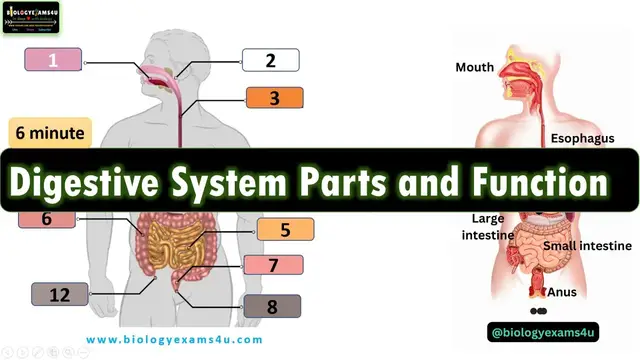
6 Minute video with animation explaining 12 parts of digestive system
⌚Stamps
00:00 | How food moved through the body?
00:37 | Components of digestive system Alimentary canal
00:53 | Accessory organs of digestive system
01:00 |How digestive system works?
01:39 |Mouth Functions
01:58 |Salivary gland Functions
02:21 |Esophagus Functions
02:37 |Stomach Functions
03:05 |Small intestine Functions
03:28 |Large intestine Functions
03:45 |rectum Functions
03:56 |Anus Functions
04:20 |Liver Functions
04:36 |Gallbladder Functions
04:49 |Pancreas Functions
05:04 |Appendix Functions
05:23 |Summary Digestive System
============================================================
Show More Show Less View Video Transcript
0:00
First let us understand how food travels through the body during digestion. It starts with mouth
0:08
then the foot moves to the esophagus, then it moves to the stomach where it is further digested
0:16
then the digested matter moves to the small intestine where absorption of nutrients takes
0:22
place. Then it enters the large intestine and the waste is removed through the anus. As you see
0:30
this is a long tube starting from mouth to anus and this is called the elementary c. So the
0:37
digestive system is made up of two components. First one is the elementary c starting from
0:42
mouth to anus through which the food moves. It includes mouth, esophagus, stomach, small intestine
0:49
large intestine, anus, rectum, etc. The second component are the accessory organs like liver
0:56
gall, bladder, salivary glands, etc. The digestive system works by a series of mechanical and chemical
1:03
processes. The mechanical process involves chewing, mixing and moving of this food through this
1:09
elementary c. The chemical processes involves a secretion of enzyme for digesting these complex
1:15
molecules into smaller molecules the nutrients are absorbed into the bloodstream through the
1:21
walls of the small intestine the absorbed nutrients are then transported to different cells throughout the body where they are used for energy growth and repair Now let us see the function of each of the structures of the digestive system within three to five minutes
1:38
Starting with mouth. Mouth is involved in the ingestion of food, chews and mixes food with saliva. It is a place where the mechanical breakdown of carbohydrates
1:50
and lipids begins. Lipid breakdown by means of lingual lipase. It's also involved in moistening
1:56
the food. The second structure is the salivary glands and salivary glands lubricate mouth with
2:03
saliva, helps in salowing and also helps in digestion. It produces saliva that mixes with
2:09
the food that also helps in the breakdown of carbohydrates, also kills harmful bacteria
2:14
Then the foot moves through this throat which is also called as pharynx that pushes the foot down
2:21
into the esophagus, this long tube that transport food from pharynx to the stomach. Esophagus is a
2:29
muscular long tube that transports food from pharynx to the stomach by peristalsis. Stomach
2:37
is involved in the mechanical and enzymatic digestion of food. It stores food, churns it
2:44
with hydrochloric acid and enzymes, digestive enzymes, gastric juices all helps to digest the
2:50
food. It mixes and churns food with gastric juice to form chyme. Here the breakdown of
2:56
protein starts So in the stomach breakdown of protein starts So there are digestive enzymes like proteases that is involved in breakdown of proteins Then the food moves to the small
3:08
intestine. Small intestine is the main site of digestion and absorption of nutrients. Here the
3:15
end products of digestion are absorbed or nutrients are absorbed into the bloodstream through the
3:20
walls of the small intestine. Here the food moves slowly as absorption takes place and the remaining
3:27
undigested matter moves to the large intestine. Large intestine absorbs water and electrolytes
3:34
from food and passes waste products out of the body. It also absorbs vitamins produced by
3:41
enderic bacteria. It stores waste products and also eliminates waste products from the body
3:47
Then these waste products moves to the rectum. It is a structure that stores waste products
3:53
or feces before elimination and finally the anus, the opening through which waste products are
4:00
eliminated from the body. So this is how food moves through the body during digestion starting
4:06
from mouth to the anus. During the process the nutrients are absorbed in small intestine. So
4:12
these structures forms the elementary c that starts from mouth to the anus. Now there are
4:19
accessory organs. The first one is the liver. Liver produces bile which is necessary for digestion
4:26
and absorption of fats It stores glycogen It also is involved in detoxification of harmful substances The next one is the gallbladder As you see here this is a gallbladder
4:41
It stores bile which is released into the small intestine when needed that is essential for
4:47
digestion of fats. And the next structure is the pancreas which is a gland that produces
4:53
digestive enzymes and bicarbonates which help to digest carbohydrates, proteins and fats
4:59
It also produces insulin, a hormone that regulates blood glucose levels. And the final structure is
5:05
the appendix, a small finger-shaped pouch that projects from the cecum. The exact function of
5:13
appendix is not known, often considered as a vestigial organ. So these are the major structures
5:19
or organs involved in digestion. So let me summarize. So human digestive system is a complex
5:26
system of organs that breaks down food into nutrients that the body can absorb and use for
5:33
energy growth and repair. It is made up of two components. First one is the elementary c
5:38
that starts from mouth to anus a long sack through which the food moves. It has different parts like
5:47
mouth, esophagus, stomach, small intestine, large intestine, rectum, anus. There are accessory organs
5:53
that helps in digestion like liver, gallbladder, pancreas, etc. Hope you understand the process of
6:00
digestion. Take care. Stay blessed. Thank you so much. You are with biology examsforay.com
#Food & Drink
#Food
#Breakfast Foods
#Meat & Seafood
#Health
#Nutrition