Up next in 10

Digestion and Absorption of Carbohydrates, Fats, Proteins, Nucleic acids, vitamins and Electrolytes
Sep 10, 2023

In this 12 minute video, we delve into the fascinating topic of digestion and absorption, providing a comprehensive understanding of how our bodies break down various nutrients. Join us as we explore the intricate processes involved in the breakdown of carbohydrates, fats, proteins, nucleic acids, vitamins, and electrolytes.
Happy Learning ✌️
⌚ Stamps
00:00|| Introduction
01:26|| Digestion and Absorption of Carbohydrates
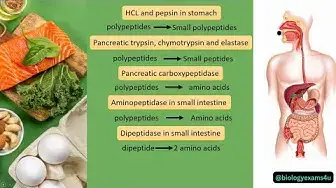
04:16|| Digestion and Absorption of Proteins
06:35|| Digestion and Absorption of Fats
09:18||Digestion and Absorption of Nucleic acids
10:05||Digestion and Absorption of Water electrolytes and Vitamins
============================================================
We really appreciate your support ?
Thank you so much :)
@biologyexams4u
▶Enroll now. Our free certificate course on Introduction to Recombinant DNA Technology
https://alison.com/course/introduction-to-recombinant-dna-technology?utm_source=alison_user&utm_medium=affiliates&utm_campaign=22177687
?Introduction to Recombinant DNA Technology – Download free E Book
https://www.biologyexams4u.com/2022/09/enroll-now-new-online-course-on.html
==============================================================
Show More Show Less View Video Transcript
0:00
Hi friends, in the last video we discussed about the functions of digestion system
0:05
In this video, let us understand how the nutrients are absorbed during the process of digestion
0:11
These are the major nutrients that is present in the food, that is carbohydrates
0:16
The absorbable form is monosaccharides like glucose, galactose and fructose. Proteins should be broken down to amino acids, dipeptides or tripeptides for absorption
0:27
whereas triglycerides or lipids should be broken down to glycerol and free fatty acids
0:32
whereas nucleic acids must be broken down to pentose sugars, phosphates or nitrogen spaces
0:38
for absorption into the body. Let us understand how this occurs within 5 to 10 minutes. Let's take
0:45
an example for better understanding as you see. So here the starch in mouth, carbohydrates are
0:52
broken down by salivary amylase. Then further digestion into smaller molecules takes place
0:56
in stomach and also in small intestine. As you see, this complex starch molecule is broken down
1:02
into monosaccharides or disaccharides and finally forming the absorbable form glucose that is taken
1:09
by the absorptive cells or absorptive epithelium of the small intestine and finally reaching the
1:16
blood vessel. So this is what is happening. So digestion is all about converting this complex
1:22
biomolecule into simple absorbable forms. Now let us move into the detail of digestion and
1:29
absorption of carbohydrates. The carbohydrates we eat is first acted upon by salivary amylase
1:37
in mouth. So in mouth salivary enzyme has salivary amylase. Cooked starch is converted to maltose
1:44
which is a disaccharide that is made up of two glucose units. Salivary amylase is also present
1:49
in stomach there also it converts starch into maltose. Then pancreatic amelase in small
1:56
intestine. Majority of absorption and digestion takes place in small intestine. As you see cooked
2:02
and uncooked starch is converted to maltose. Three enzymes in small intestine. The first one is
2:07
maltese. Maltese converts maltose which is a disaccharide into two glucose units. Then lactase
2:15
in small intestine that convert lactose which is a disaccharide into calactose and glucose
2:21
and finally sucrose in small intestine convert sucrose to fructose and glucose and all these
2:27
simple molecules or monosaccharides can be absorbed by the small intestine, absorptive cells of the
2:34
small intestine. So this is a summary the glycogen or starch that we take in is acted upon by salivary
2:41
amelis forming disaccharides like maltose sucrose or lactose and that is further acted upon by
2:47
maltase sucrose and lactase that is present in small intestine breaking down into monosaccharides
2:53
like glucose glucose fructose and galactose 80 percent of the food is absorbed as glucose in the small intestine The major site of absorption is the jejunum of small intestine and finally this is how the absorption happens Carbohydrates is broken
3:14
down into glucose then the transportation absorption mechanism is by means of co-transport
3:20
with sodium ions or it is also called a sodium glucose transporter then that enters into the
3:27
capillary blood in villi, then the destination is liver via hepatic portal vein. In the case of
3:35
galactose, the same happens by means of sodium glucose transporters. The moment is into the
3:41
capillary blood in villi, then the destination is liver via hepatic portal vein. And finally
3:48
fructose is the moment is by facilitated diffusion. It enters into the bloodstream by capillary blood
3:54
in willy then destination is liver via hepatic portal vein. So this is how the absorption of
4:00
carbohydrates takes place. Then there are other transporters like glute is also involved. Glucose
4:07
transporter called glute is also involved in transport mechanism. Hopefully we will be
4:12
discussing the transport mechanism in another video. Now moving into the digestion and absorption
4:18
of proteins. The first site of protein digestion is the stomach. Hydrochloric
4:25
acid present in the stomach denatures the protein and the pepsin, the enzyme
4:30
that acts on acidic pH that is present in the stomach converts these polypeptides
4:35
or long proteins into small polypeptides. Then pancreatic trypsin, chymotrypsin and elastase that is released by pancreas converts polypeptides into small
4:46
peptides. Then pancreatic carboxypeptidase converts polypeptides into amino acids. Then amino peptidase in small intestine. Small intestine is a major site of digestion and absorption. Further
4:59
polypeptides induce amino acids. Whereas dipeptidase in small intestine convert dipeptide into two
5:06
amino acid units. So this is the summary. Protein is acted upon by pepsin in the stomach. Then large
5:13
polypeptides becomes small short peptides then further degraded to amino acids or short peptides
5:20
by means of chymotrypsin, trypsin etc and further broken down into amino acid by means of enzymes
5:27
in small intestine like narboxypeptidase, aminopeptidase, dipeptidase etc. This is a summary
5:35
of protein digestion. It happens in the stomach by means of hydrochloric acid and pepsin. Then
5:41
pancreas releases enzymes that digest these polypeptides into short peptides. Then small
5:47
intestine enzymes like dipeptidase, aminopeptidase etc breaks down protein into amino acids. It is a
5:54
site of final digestion of protein and absorbed amino acid enters the blood and travel to the
6:00
liver and liver regulates the distribution of amino acids to different parts of the body the main site of absorption of protein is proximal jejunum of small intestine And finally regarding the transport of or absorption of protein
6:14
proteins are broken down in building blocks called amino acids which is the absorbable form
6:19
Absorption mechanism by means of co-transport with sodium ions just like carbohydrates
6:24
It enters into the bloodstream just like carbohydrates. Capillary blood in villay
6:28
then destination is liver via hepatic portal vein where it is distributed to different parts of the
6:34
body and the next is the fats or lipids. The digestion of fats or lipids starts in mouth by
6:41
means of lingual lipase. These triglycerides are converted to free fatty acids and diglycerides
6:47
by lingual lipase. Then the gastric lipase that is present in stomach converts triglycerides to
6:54
free fatty acids and diglyceride. Then pancreatic lipis converts triglycerides to two free fatty
7:02
acids plus monoglyceride. So this is happening. This is a triglyceride, a glycerol with three
7:07
fatty acids attached. So pancreatic lipis converts this into a monoglyceride and two fatty acid
7:14
genes. The major site of lipid digestion is and absorption is diodenum of small intestine
7:21
so this is happening regarding the transport or absorption of lipid so this is the fatty acids
7:28
and monoglycerides that is released then later this forms a missile or emulsion then this leaves
7:35
the missile and enters the epithelial cell so this is the absorptive epithelial cell and fatty
7:41
acids links to triglycerides then later it binds with protein and finally forming
7:47
chylomicrons in colchia apparatus. Then chylomicrons are released from the epithelial cell by means of exocytosis and enters into the lymph capillary. So lymph capillary transports this
8:01
chylomicron away from the intestine into the bloodstream and so this is how the absorption
8:07
happens. Lipids are broken down into long chain fatty acids. In the case of long chain fatty acids
8:13
diffusion occurs into the intestinal cells where they are combined with proteins to form
8:19
chylomicrons so lipids can easily pass through this membrane as plasma membrane is also made up
8:25
of phospholipids by diffusion so entry into the bloodstream by means of lacteals of villi then
8:32
destination is systemic circulation via lymph entering thoracic duct in the case of monoglycerides
8:37
the same thing happens diffusion then movement into the bloodstream via lacteals of willy then
8:44
destination is systemic circulation via lymph entering thoracic duct. In the case of short
8:49
chain fatty acids it can enter into the intestinal cells by simple diffusion then entry into the
8:55
bloodstream by capillary blood in willy then destination is liver via hepatic portal vein
9:01
In the case of glycerol glycerol can also move by simple diffusion enters into the bloodstream by capillary blood in willy and finally the destination finally the destination is liver via hepatic bottle vein from there these molecules are distributed to different sides of the body
9:17
and the next one is the absorption and digestion of nucleic acids. Nucleic acids include RNA and
9:24
DNA, deoxyribonucleic acid and ribonucleic acids that is broken down into the building blocks
9:29
called nucleotides by pancreatic nuclease. Then in the small intestine there is an enzyme called
9:35
nucleotidase that converts this nucleotide into nucleoside and phosphate then another enzyme in
9:41
small intestine that is nucleosidase that converts this nucleoside into pendose and nitrogenous
9:48
bases birene and pyrimidine bases and that can be absorbed easily absorbed so this is the absorbable
9:54
form when those nitrogenous bases are so pendose absorption by means of passive diffusion whereas
10:00
nitrogenous bases are absorption by means of active transport. Now let us understand the absorption
10:07
of water, other electrolytes, vitamins etc. A quick summary. Water is absorbed from stomach
10:14
small and large intestine by means of diffusion. Maximum absorption takes place at jejunum. 90
10:19
of water absorption takes place in small intestine. Then sodium, the case of sodium
10:24
it is reabsorbed along with glucose in small intestine with sodium glucose transporter
10:30
the presence of glucose in the intestinal lumen facilitates sodium reabsorption. In the case of
10:38
chloride ions, it is absorbed along with sodium to maintain electrical neutrality. This is negatively
10:44
charged where sodium is positively charged. In ileum and choline, chloride ion is reabsorbed in
10:50
exchange of bicarbonates. Regarding calcium, calcium is actively absorbed in the detinum and
10:57
jejunum depending on body's needs. Calcitriol which is the active form of vitamin D that is made in
11:03
kidney increases calcium absorption from the intestine. The next one is iron an important
11:08
component of hemoglobin and myoglobin. Dietary iron is in ferric form that should be reduced to
11:14
ferrous form by hydrochloric acid and ascorbic acid in the stomach for absorption. Maximum
11:19
absorption takes place in the detinum. Then regarding the vitamins the small intestine
11:24
absorbs the vitamins that occurs naturally in food. Fat-soluble vitamins ADEK are absorbed along
11:33
with dietary lipids in mesal via simple diffusion whereas water-soluble vitamins including B vitamins
11:39
and vitamin C are absorbed also absorbed by simple diffusion. Vitamin B12, a very large molecule
11:46
is absorbed in the distal ileum by receptor mediated endocytosis and this is
11:54
about the digestion and absorption of different nutrients. Leaving you with a
12:00
video on functions of digestive system and the processes associated with digestion. The link is here. Hope this video is beneficial. Take care. Stay blessed
12:11
Thank you so much. You are with biology exams for you dot com
#Health
#Health Education & Medical Training
#Nutrition