0:00
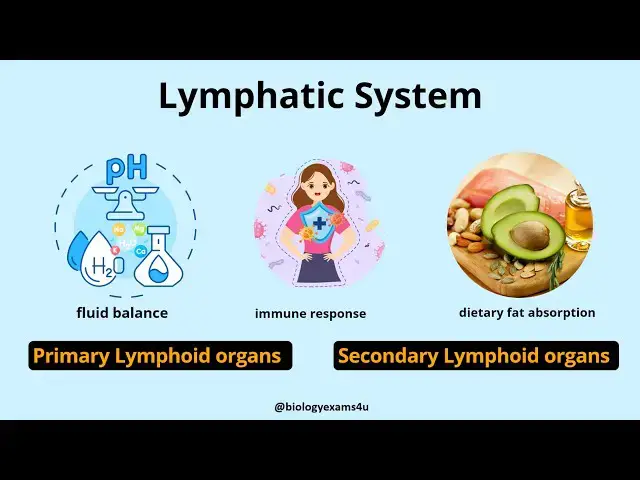
The lymphatic system is a network of
0:02
tissues, organs and vessels that helps
0:04
maintaining fluid balance that include
0:07
water balance and electrolyte balance.
0:10
Defends the body against infection or
0:12
immune response and also helps in
0:15
dietary fat absorption. In this video,
0:18
we are going to discuss the difference
0:19
between primary lymphoid organs and
0:21
secondary lymphoid organs. The lymphoid
0:23
organs are classified into primary and
0:25
secondary based on their roles in the
0:27
development and function of lymphocytes.
0:30
Let us understand with examples. The
0:33
primary lymphoid organs are bone marrow
0:35
and thymus. So this is a bone marrow.
0:38
This is a site where bell production and
0:40
maturation takes place. And the second
0:45
In thymus T- cell maturation takes
0:47
place. T cells are produced in bone
0:49
marrow but maturation takes place in
0:52
thymus. So primary lymphoid organs are
0:55
sites where lymphosytes are produced and
0:58
mature. The secondary lymphoid organs
1:01
include lymph nodes, spleen, mucosa
1:05
associated lymphoid tissue like tonsils,
1:08
pis patches, appendix etc. These are the
1:11
sides where mature lymphosytes become
1:13
functional and initiate immune
1:15
responses. Difference number two in
1:17
primary lymphoid organs like bone marrow
1:20
and thymus these lymphosytes
1:24
and also under goes differentiation and
1:27
maturation to form fully functional
1:30
lymphoid cells. Whereas in secondary
1:33
lymphoid organs like spleen and lymph
1:35
nodes these lymphosytes are activated
1:38
and starts division upon encountering
1:40
with an antigen. Suppose this is a B
1:42
cell and this is an antigen. This B cell
1:46
has specific receptors specifically
1:48
designed to bind to epitops of an
1:51
antigen. So upon binding of this B cell
1:54
to antigenic epitop, this B cell is
1:58
activated and starts dividing forming
2:01
clones of B cells with the same
2:03
specificity. In secondary lymphoid
2:06
organs, activation and proliferation of
2:09
lymphosytes takes place upon
2:12
encountering an antigen. Difference
2:14
number three in primary lymphoid organs
2:17
like thymus and bone marrow there is no
2:19
direct contact with foreign antigens. As
2:21
you see production and maturation takes
2:24
place in bone marrow and thymus without
2:26
the involvement of foreign antigens.
2:28
Only self antigens are present in these
2:31
sites. Whereas secondary lymphoid organs
2:34
there is direct contact with foreign
2:35
antigen that stimulates immune response
2:38
while lymphosy activation. As we
2:40
mentioned earlier, this B cell can bind
2:43
to epitops of antigens. Upon binding to
2:47
the epitops of antigen, this B cell is
2:49
activated and stimulates immune response
2:52
by the activation of this lymphocy. Now
2:55
regarding the function primary lympoid
2:57
organs the primary function is
2:58
hematopois or reduction of all blood
3:01
cells takes place in bone marrow both
3:03
lymphosytes and other blood cells. The
3:07
second function is imunoglobilin TCR
3:09
gene rearrangement. So that happens this
3:12
B cell precursors undergo a WDJ
3:15
rearrangement or re combination to
3:17
generate diverse B cell receptors that
3:20
is specific against epitops of different
3:22
antigens and third function is central
3:24
tolerance which is a fundamental
3:26
imunological process that eliminates
3:29
self-reactive lymphosytes during their
3:31
development preventing autoimmune
3:33
response. So as you see here in this
3:36
case this mature T- cells has high
3:39
affinity for self antigens so that these
3:43
T- cells are selected and that is
3:45
destroyed by apoptosis or program cell
3:49
death. This mechanism ensures immune
3:51
cells do not attack bodisol tissues. The
3:55
functions of secondary lymphoid organs
3:57
include antigen presentation.
4:00
Suppose this is an APC antigen
4:02
presenting cells like dendritic cells or
4:05
macrofasages that presents antigen to a
4:07
lymphocy like B cell or T cell. Upon
4:10
activation here you can see there is B
4:12
cell 1, B cell 2 and B cell 3. BL 2 has
4:15
a receptor that is that can bind to this
4:17
antigen. So this particular B cell 2 is
4:20
activated and this single lymphocy upon
4:24
binding to a specific antigen divides or
4:28
proliferates rapidly producing
4:30
genetically identical cells or clones
4:33
and this is called as clonal expansion
4:36
or that particular B cells is selected
4:38
to divide and proliferate to form large
4:41
number of B cell with a specific
4:44
specificity targeting this particular
4:46
antigen. And the next step is adaptive
4:48
immune response. This particular B cell
4:51
that is B cell 2 lymphocytes under goes
4:54
differentiation to form plasma cells and
4:57
memory B cells. These plasma cells are
4:59
involved in secretreting antibodies that
5:01
has specificity towards this antigen and
5:04
these antibodies bind to this antigen
5:06
finally ensuring its clearance from the
5:09
system. Memory B cells are also produced
5:12
and that is involved in imunologic
5:14
memory. When the antigen comes for a
5:16
second time, there will be an enhanced
5:19
immune response because of the presence
5:20
of memory B cells. For more details, you
5:23
can watch our videos on this topic. You
5:25
can check out our imunology video
5:29
simplified versions of different aspects
5:31
of our immune system. So these are some
5:34
of the titles. Hope you are benefited
5:36
from this video. Take care, stay
5:37
blessed. Thank you so much. You are with