0:00
First let us understand what is central
0:02
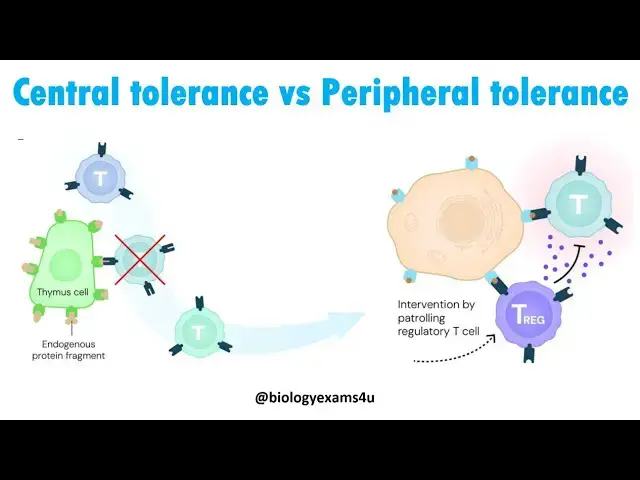
tolerance. It is defined as a process
0:04
where T- cells that recognize bodisone
0:07
proteins or cells are eliminated while
0:10
maturing in the thymus. Let's make it
0:12
more clear. As we know this T- cells
0:16
like B cells originates in bone marrow
0:19
but T- cells maturation takes place in
0:21
thymus. Every T- cell has a unique T-
0:24
cell receptor that is specifically
0:27
designed to interact with a specific
0:29
epitope of the antigen or it can attach
0:31
to a specific antigen. These T- cells
0:34
during maturation thymus hold out
0:37
bodisone fragments to the T cells. If
0:40
this T- cell interact with bodisone
0:42
fragments that T- cells that interact
0:46
self cells or self proteins are
0:48
eliminated. So this process called as
0:51
central tolerance that ensures
0:54
prevention of autoimmune response. So T
0:56
cells that attach to parts of bodisone
1:00
proteins is selected and that will be
1:02
eliminated from the system. The other T-
1:04
cell that pass this test or that fail to
1:07
attach to self proteins or that cannot
1:10
interact with self proteins or self
1:12
cells are selected and they will move
1:16
into the body to look for pathogens. So
1:18
this is called central tolerance that
1:21
efficiently prevents autoimmune
1:24
response. Now the next question is what
1:27
happens if some of the ste cells slip
1:30
through this test. Here comes the
1:32
peripheral tolerance. Peripheral
1:34
tolerance is a set of mechanisms that
1:37
prevent the immune system from attacking
1:39
the body's own tissues after mature
1:41
immune cells have left the thymus and
1:43
bone marrow. It is just like a backup to
1:46
central tolerance ensuring self-
1:48
reactive T and B cells that escape
1:51
central selection is either deactivated
1:55
or deleted in the peripheral tissues and
1:57
lymph nodes thus preventing autoimmune
1:59
disease. Now let us understand how this
2:02
works. This peripheral tolerance is
2:04
mediated by a group of cells called
2:06
regulatory T- cells. Suppose this is a
2:08
T- cell that has slipped through the
2:10
test or central tolerance test. So this
2:13
T- cell can interact with self proteins.
2:17
So this T cell is interacting with
2:19
endogenous protein fragment or self
2:21
protein. Then petroleing regulatory T
2:24
cells can intervene. This regulatory T
2:26
cells finds this D cell that is
2:28
attacking or interacting with self cells
2:31
and this T regulatory cells discover
2:33
that this attack is by a mistake and
2:35
calm it down or deactivate or eliminate
2:38
it by further response. Thus ensuring
2:41
that these T- cells cannot harm self
2:44
cells or thus preventing the autoimmune
2:47
disease or autoimmune response. So this
2:49
is called peripheral immune tolerance
2:51
where the mechanism that prevent the
2:54
immune system from attacking body own
2:57
tissues after mature immune cells have
3:00
left the thymus and bone marrow or slip
3:02
through the central tolerance test. Hope
3:05
you are clear. The Nobel Prize in
3:07
physiology or medicine 2025 was awarded
3:10
for explaining peripheral immune
3:13
tolerance or that is maintained by T
3:15
regulatory cells and that is coded by a
3:18
gene called Fox P3 gene. We have given a
3:21
simplified video on this Nobel Prize
3:24
work. You can watch that video also.
3:26
Hope you understand the difference
3:27
between peripheral and central immune
3:29
tolerance. Take care, stay blessed.
3:30
Thank you so much. share with biotic