0:00
In 1943, T.M. Sonneborn, for the first
0:03
time, reported a new mechanism of
0:07
In his words, "The present paper reports
0:09
a previously unknown system of relations
0:12
between a gene and a cytoplasmic
0:14
substance, both of which are required
0:16
for the development of an hereditary
0:19
The mechanism was called the cytoplasmic
0:22
inheritance, the inheritance of kappa
0:24
particles in Paramecium aurelia.
0:27
In this video, we'll be discussing
0:29
the cytoplasmic inheritance of kappa
0:31
particle. What are kappa particles and
0:33
why is it called as cytoplasmic
0:35
inheritance within 5 to 10 minutes?
0:38
If you are new to this channel, please
0:39
consider subscribing to this channel.
0:42
Let's move into the detail of this
0:45
Point number one, there are two
0:46
Paramecium strains. The first one is
0:49
called the killer Paramecium, and the
0:51
second one is called the sensitive
0:55
To become a killer, the Paramecium
0:57
should have two prerequisites. First
1:00
one, a nuclear gene, which is called as
1:02
capital K gene, either in homozygous,
1:05
that is capital K capital K, or
1:07
heterozygous condition, capital K small
1:10
Along with that, there should be a
1:12
cytoplasmic particle,
1:14
which is called as kappa particle. These
1:17
two things are essential for a
1:19
Paramecium to become killer.
1:22
What is actually happening is this kappa
1:24
particle secretes a toxin, which is
1:27
called as paramecin, and this toxin,
1:30
upon ingestion by the sensitive
1:32
Paramecium, this is toxic to the
1:34
sensitive Paramecium, causing its death
1:38
That's why this is called as sensitive
1:39
Paramecium. Whereas, a sensitive
1:42
Paramecium has small k small k, that
1:44
makes it sensitive, no dominant K gene.
1:48
Even this Paramecium has capital K
1:51
capital K or capital K small k,
1:53
homozygous or heterozygous condition,
1:57
Without kappa particle, it remains
2:00
And finally, with kappa particle, if
2:03
this sensitive paramecium has a
2:08
then also it becomes sensitive. In
2:10
short, to become a killer paramecium,
2:13
two things are essential. First, a
2:15
dominant K gene along with kappa
2:19
Both are essential to become a killer
2:21
paramecium. Now, let us see the summary
2:24
of the study carried out by Sonneborn.
2:27
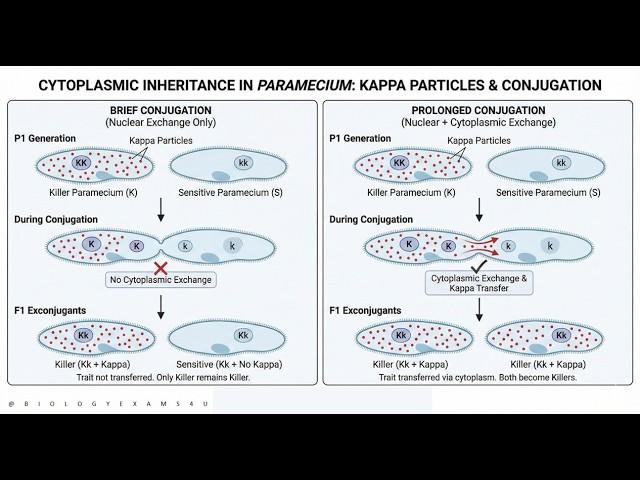
He found out that during a brief
2:29
conjugation between killer paramecium
2:31
and sensitive paramecium,
2:34
killer paramecium capital K capital K,
2:36
whereas sensitive paramecium capital K
2:38
small k, killer has kappa particle also.
2:42
During the conjugation, there is no
2:45
during brief conjugation. This K gene is
2:50
and the small K gene is transferred to
2:52
this killer paramecium. Now, the F1
2:55
exconjugants are the killer paramecium
2:57
becomes capital K small k, that is
2:59
heterozygous condition. The small K gene
3:01
is transferred from the sensitive
3:04
whereas sensitive paramecium becomes
3:06
capital K small k in heterozygous
3:08
condition. This capital K is transferred
3:10
from killer paramecium, but it remains
3:12
sensitive as there is no transfer of
3:15
kappa particles. So, killer remained
3:18
killer as it has dominant K gene along
3:20
with kappa particle, whereas sensitive
3:23
remains sensitive as it has only the
3:26
dominant gene, but no kappa particle.
3:29
So, there is no cytoplasmic exchange,
3:32
only nuclear exchange takes place during
3:34
this brief conjugation.
3:37
Now, let us see the second conjugation.
3:40
In prolonged conjugation, he found out
3:42
this killer paramecium and sensitive
3:44
paramecium, during prolonged
3:46
conjugation, there is both cytoplasmic
3:48
exchange and nuclear exchange. This
3:51
capital K is transferred to the
3:55
and kappa particle is also transferred
3:57
by the formation of a cytoplasmic bridge
4:00
during prolonged conjugation.
4:03
As a result, the F1 exconjugants are the
4:07
small k and capital K, that is
4:09
heterozygous condition. There is a
4:11
dominant K gene along with kappa
4:12
particle. Killer remain killer, whereas
4:16
the sensitive Paramecium is transformed
4:19
into killer Paramecium as it has the
4:22
capital K gene that is transferred by
4:24
the nuclear transfer. And also there is
4:26
cytoplasmic transfer. There is
4:28
cytoplasmic exchange. Therefore, kappa
4:30
particles are also transferred from this
4:33
killer Paramecium to the sensitive
4:35
Paramecium. That's why
4:39
So, the trait is actually transferred
4:42
via cytoplasm. That's why this is called
4:44
as cytoplasmic transfer. Let me
4:47
summarize. During brief conjugation
4:49
between a killer Paramecium and
4:51
sensitive Paramecium,
4:52
both remains the same. The killer
4:55
remains the killer and sensitive remains
4:57
the sensitive as only nuclear exchange
5:01
But during a prolonged conjugation
5:03
between killer Paramecium and sensitive
5:06
there is both nuclear exchange and
5:09
cytoplasmic exchange. So, along with
5:12
transfer of capital K gene,
5:14
kappa particles are also transferred.
5:17
the sensitive is transformed into
5:21
And that happened during the cytoplasmic
5:25
Now, let me make it more clear.
5:28
So, what is cytoplasmic inheritance?
5:30
It's a type of genetic transmission
5:32
where traits are inherited through the
5:34
genes located in the cytoplasm rather
5:39
So, in killer Paramecium, there is
5:41
capital K gene that is residing in the
5:43
nucleus, whereas kappa particles are
5:45
essential. So, kappa particles
5:48
is located in the cytoplasm.
5:51
And this particle, now we know that this
5:52
is actually an endosymbiotic bacteria,
5:55
Caedibacter taeniospiralis, living
5:57
within the cytoplasm of Paramecium.
6:00
So, this bacteria has genes
6:03
that secretes toxin called paramecin
6:07
sensitive Paramecium.
6:09
Then, the host must have nuclear K gene.
6:12
The K gene must be essential for making
6:14
this paramecin killer. Kappa particle
6:16
alone cannot make this paramecin killer.
6:19
As this K gene is essential for the
6:22
multiplication and survival of kappa
6:26
Now, why it is called as cytoplasmic
6:30
The reason is the physical location of
6:34
that determines the killer trait, that
6:38
is inside the cell cytoplasm, not inside
6:40
the nucleus. And it does not follow
6:43
Mendelian laws. So, cytoplasmic transfer
6:46
along with nuclear transfer only
6:49
transforms a sensitive Paramecium to a
6:53
killer Paramecium. That means the
6:55
physical location of the genetic factor
6:58
that determines the killer trait is in
7:01
the cell cytoplasm, that is a kappa
7:03
particle. Now, we know that these are
7:04
genes inside this endosymbiotic bacteria
7:07
that is located in the cytoplasm.
7:11
So, hope you are clear with the
7:12
cytoplasmic inheritance of inheritance
7:14
of kappa particles in Paramecium
7:17
Hope you are benefited from this video.
7:19
Take care. Stay blessed. Thanks for