0:00
Hi friends, hope you are fine. In this video, let us understand the stages of pathogenesis
0:05
Pathogenesis refers to a series of events from initiation to the development of a disease that
0:11
is caused by a pathogen or disease-causing organism. Now let us understand the stages
0:17
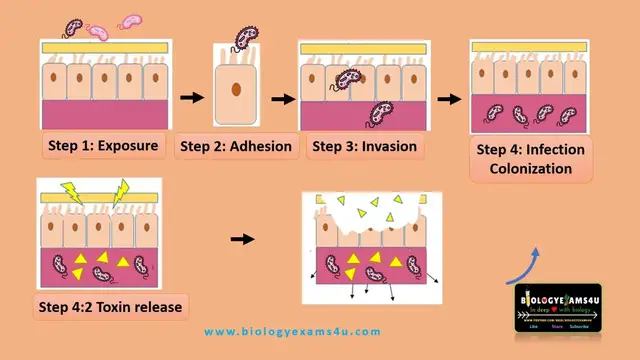
of pathogenesis. Suppose this is the mucous membrane and this is the epithelial cell
0:22
and this is the underlying tissue. Step 1 is the exposure to the pathogen. Contact with a
0:29
potential pathogen is called as the exposure. So pathogen comes in contact. There are different
0:36
entry routes like all the openings eyes, mouth, respiratory tract, then wounds or operations in
0:43
skin, urogenital tract, gastrointestinal tract, all are openings through which pathogen can enter
0:49
into the body system. The second step is adhesion. Adhesion is very important as innate defense
0:56
mechanism of our body like the peristaltic movement of our gut, urination, sweating, tears
1:03
all these removes the pathogen from the system or washes out the pathogen from the system
1:09
So adhesion is a critical step as far as pathogen is concerned for causing a disease
1:16
Pathogen adhers to the cell by means of flagella, pili in the case of bacteria
1:22
and this has many proteins or carbohydrate components like adhesins that helps to attach to the cell surface
1:32
This attachment is very critical as the innate defense system will flush out the pathogen if not attached to the cell Or this pathogen has some proteins that binds to specific receptors on the host cell The next step
1:47
is invasion. Once attached, the pathogen enters and spreads into the tissues by means of invasion
1:55
by producing certain proteins, certain toxins or by endocytosis and there are class of proteins
2:01
called invasins that helps in entry of this pathogen from epithelial cell or the surface
2:08
to the interior tissues. So this can be maybe by endocytosis, this plasma membrane invaginates
2:15
by means of certain signals assisting the pathogen to enter into the cell or by secreting toxins or
2:21
proteins or by binding to certain specific cell surface receptors that assist in movement of
2:26
pathogen. Now pathogen has reached the tissue. Take the case of Helicobacter pylori. So contact
2:33
with stomach acid keeps this mucin lining, a spongy gel-like state so that this Helicobacter
2:39
pylori cannot penetrate. So this bacterium releases urease which neutralizes the stomach acid
2:46
so that this mucin becomes liquefied so that bacteria can swim through it towards the epithelial
2:54
cell. Once invaded, the next step is infection, causing infection. The first
3:00
step in causing infection is colonization. Bacteria starts replicating very quickly and the number of bacteria increases, drastically increases within
3:10
the tissue Then it starts secreting toxins endotoxins and exotoxins and enzymes like shiga toxin by shikala then tetanus by clostridium tetani botulinum by botulism all are toxins that ultimately causes the destruction
3:27
of cells and tissue damage. Once the tissue damage becomes severe, there will be some disease
3:34
manifestation. So this infection may be local or systemic. Local means in the case of streptococcus
3:41
aureus that causes hair follicle infection. There will be boils that is localized on specific
3:48
regions on the head. So urinary tract infection, it is also a type of local infection that is
3:56
restricted to a localized region. When this infection spreads and spreads to different
4:01
organs or multiple organs or throughout the system, then it is called a systemic
4:06
Take the case of pneumonia. Pneumonia starts in the respiratory attack, then moves to lengths
4:10
First, it is a localized infection but once in the bloodstream, it can move throughout the body
4:16
causing many disease symptoms and ultimately the disease become systemic. That infection becomes
4:23
systemic affecting multiple organs all or the entire body. In the case of viruses
4:29
chickenpox virus, all are examples of systemic infection that is affecting multiple organs or
4:36
throughout the body. After a successful infection for the pathogen to persist it
4:41
should be transmitted to the another host. Just like entry route there are many
4:47
exit routes for pathogen like urogenital tracts respiratory tracts all the openings these are all exit routes through skin secretions and excretions semen vaginal secretion tears All are roots through which pathogen can move from a deceased
5:05
host to the another one, a healthy individual. Some pathogen even release on insects to transmit
5:12
the disease. So this is how pathogenesis works or mechanism of pathogenesis. Let me conclude
5:19
starting with exposure. Host comes in contact with a potential pathogen then the pathogen
5:26
adhers to the cell surface by means of adhesives or some cell surface receptors then it invades
5:32
into the tissue underlying tissue by means of invasions or by endocytosis or by releasing some
5:39
proteins or toxins. Once inside the tissue it replicates and produced in large number starts
5:46
releasing toxins that can damage the tissues. The tissue damage increases. There will be
5:52
manifestations of disease, ultimately causing severe disease. Infection can be local or systemic
5:59
Local means the infection occurs in a localized area, whereas systemic means it occurs or spreads
6:04
to multiple organs or throughout the body. And finally, for a pathogen to survive, to persist
6:10
it must transmit the disease to a healthy individual new host and transmission. Just
6:14
like entry roads there are many methods by which this pathogen can move out of a deceased host and
6:21
causing disease to a healthy healthy individual. Hope you understand the mechanism and stages of
6:27
pathogenesis. I will be leaving the link of our immunology videos here. Take care. Stay blessed