0:00
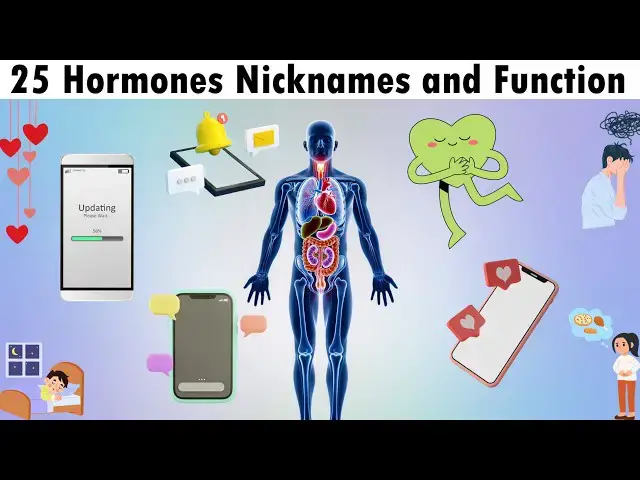
If our body were a smartphone, hormones
0:02
would be the software updates and
0:04
background notifications that tell the
0:06
hardware exactly how to behave. Our
0:09
endocrine system is constantly texting
0:11
our organs, telling our stomach when to
0:13
feel hungry, telling our eyes when to
0:16
feel tired, and muscles when it's time
0:18
to fight or fly. These chemical cords
0:21
often known by nicknames like love
0:24
hormones, stress hormone are the real
0:26
secret to how we function every single
0:29
day. In this video, we'll be discussing
0:31
25 hormones, their nicknames and why
0:33
they are called so and also their
0:35
function. Which hormone is called the
0:37
fight or flight hormone. Yes, you are
0:39
right. It is adrenaline or epinephrine.
0:42
This hormone prepares a body for
0:44
immediate action during emergencies or
0:46
high stress by rapidly increasing heart
0:49
rate, blood pressure and energy by
0:51
releasing glucose for sudden action
0:53
during stress or danger. This hormone is
0:56
also a neurotransmitter released by the
0:58
adrenal gland. The second one is a love
1:00
hormone. The love hormone is the
1:05
It promotes social bonding, trust and
1:07
intimacy between individuals that is
1:09
released during childirth,
1:11
breastfeeding, sexual activity. It's
1:13
also called as a cuddle chemical
1:16
responsible for bonding with pets and
1:18
acts of kindness or altruistic behavior
1:21
when we do something good for others.
1:23
This hormone is released helping us to
1:25
feel cush at that situation. The sleep
1:28
hormone is the melatonin
1:32
that regulates the body's internal clock
1:34
and signals when it is time to sleep. It
1:37
regulates sleepw week cycle primarily
1:40
produced by brain's pineal gland. The
1:43
next one is the stress hormone which is
1:48
It increases the glucose in the
1:49
bloodstream to help the body to deal
1:51
with the long-term stress. This produced
1:54
mainly by the adrenal gland. This not
1:57
only the stress hormone, it also helps
1:59
in restoring balance after stress. Also
2:04
Next is a sugar lowering hormone
2:07
as it is the insulin. Insulin lowers
2:10
blood sugar by helping cells absorb
2:12
glucose for energy. It is produced by
2:18
So opposite to insulin is a sugar
2:20
raising hormone. It is the glucagon. It
2:23
is produced by the pancreas. It raises
2:26
blood sugar by signaling the liver to
2:28
release stored glucose. It works just
2:31
opposite to insulin. The hunger hormone
2:37
Krelin is primarily produced from
2:39
stomach. It is a peptide hormone. It
2:41
send signals from the stomach to the
2:43
brain telling that it is a time to eat.
2:46
The next one is the satiative hormone
2:50
which is the leptin that is produced by
2:52
fat cells or adipos cells. signals are
2:55
sent from the fat cells to the brain or
2:57
adipos tissues to signal that the body
3:00
is full. It tells the brain that you
3:02
have enough energy. Next is a happy
3:05
hormone which is the serotonin
3:09
that is a tryptophan derivative
3:12
that stabilizes mood and contributes to
3:14
feeling feelings of well-being and
3:16
satisfaction. Also involved in the
3:19
feelings of happiness and calmness. Low
3:22
levels of serotonin is often linked to
3:24
depression. The next one is a metabolic
3:27
hormone which is the thyroxine or T4
3:31
which is produced by thyroid gland.
3:33
Controls the rate at which the body uses
3:35
energy or controls or regulates the
3:37
metabolic rate growth and energy use.
3:42
The next one is a milk hormone which is
3:45
the prolactin that is produced by the
3:48
pituitary gland primarily responsible
3:50
for stimulating milk production in
3:52
females and also involved in breast
3:56
The reward molecule is as you know it is
3:58
a dopamine. It is a neurotransmitter
4:02
creates feelings of pleasure and
4:04
motivation when we achieve a goal and
4:07
also helps in forming habits.
4:10
The natural painkiller is the
4:16
It is released during exercise or stress
4:18
to mask pain and provide a high often
4:22
called a feel-good chemical.
4:25
The male hormone as you know it is the
4:30
the primary hormone for developing male
4:32
physical traits and bone density.
4:36
The female hormone is the estrogen, the
4:40
primary hormone for regulating the
4:42
female reproductive system
4:44
and also for developing female physical
4:48
The pregnancy hormone is starts with P.
4:52
It is the progesterone.
4:55
It is essential for preparing and
4:56
maintaining the lining of uterus for
5:01
The water retaining hormone is the
5:06
that prevents dehydration by signaling
5:09
kidneys to conserve water. This hormone
5:12
is produced by brain. The next one is a
5:14
fitness hormone. Fitness hormone is the
5:20
that stimulates growth, cell production
5:22
and physical regeneration due to its
5:25
anabolic and fat burning activities.
5:29
The salt retaining hormone is the
5:34
which is a steroid produced by adinal
5:36
gland. Regulates blood pressure by
5:38
balancing salt and water in the kidneys
5:41
or sodium potassium balance.
5:45
The blood booster is eriththropoin
5:49
or EPO which is a glyoprotein hormone
5:52
that is primarily produced by kidneys.
5:54
It stimulates the production of red
5:56
blood cells to carry more oxygen.
6:00
The digestion trigger
6:09
or CCK which is a peptide hormone that
6:12
stimulates the digestion of fat and
6:14
protein in the small intestine by
6:17
releasing bile and pancreatic enzymes.
6:22
The master inhibitor,
6:25
the hormone is somatin.
6:28
It is a GH inhibiting hormone.
6:32
Stops the secretion of other hormones to
6:34
keep the body in balance
6:36
such as growth hormone, insulin and
6:40
That's why it is called as the master
6:45
Next is the calcium controller which is
6:47
the parathyroid hormone
6:50
which is released by parathyroid gland.
6:54
It regulates calcium levels and also
6:56
phosphorus levels in the blood to ensure
6:58
proper bone and nerve health.
7:02
The next one is a bone builder which is
7:06
that is produced by thyroid cells.
7:10
works against BDH to lower blood calcium
7:14
and protect bone density
7:18
and increases the calcium excretion by
7:20
kidney. And the final one is the heart's
7:24
blood pressure regulator which is atrial
7:26
naturureetic peptide that is released by
7:31
to lower blood pressure by removing
7:38
produced by heart's atria. So these are
7:41
the 25 hormones and their nicknames and
7:44
why they are called so. Hope you are
7:46
benefited from the video. Take care,
7:50
Thank you so much. You are with biology